
7 Key Considerations for AC-DC Converter Selection
When designing an industrial control panel, telecom rack, or medical device, choosing the right AC-DC converter has a decisive impact on the system's lifetime, reliability, and behavior in the field. These power supplies, which convert the alternating grid voltage into a constant direct voltage, may seem like a simple matter of matching the input and output voltages at first glance, but in reality, making a proper engineering decision requires considering a wide range of criteria, from efficiency and insulation class to EMC compliance and thermal dissipation. In this article, we examine seven key criteria to consider when selecting an AC-DC power supply, along with typical field errors and an engineering perspective.
By the end of this article, you will be able to apply these criteria to evaluate AC-DC converter options in the Kare Dalga catalog through practical examples.
What is an AC-DC Converter and Which Architectures are Used?
An AC-DC converter is a power converter that converts the alternating voltage from the grid (typically a wide range of 85-264 VAC or regional 230/115 VAC) to a regulated DC output. Almost all modern modules are based on switch-mode topology, which provides much higher power density and efficiency by switching at high frequency, unlike linear regulators.
A typical AC-DC power module consists of the following blocks: input EMI filter, bridge rectifier, power factor correction (PFC) module, main DC-DC converter module (usually flyback, forward, LLC resonant, or bridge topology), and output filter/feedback loop. While flyback is an economical choice at low powers, LLC resonant and half- or full-bridge topologies are preferred for applications requiring high power and efficiency. The topology used directly affects efficiency, noise profile, and physical size.
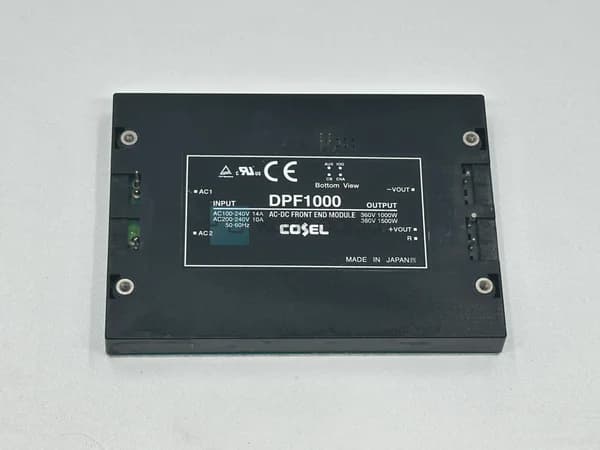
 High-power AC-DC modules such as the Cosel DPF1000 are preferred in industrial systems with PFC solid-state integrated structures. Cosel DPF1000 AC-DC Converter
1. Input Voltage Range and Grid Tolerance
The first criterion is the characteristics of the network in which the module will operate. For an international device, a model that supports universal input
(85-264 VAC, 47-63 Hz) allows you to operate with a single stock code in different markets. In a fixed installation, a narrow-range model may provide a cost advantage.The point that is often overlooked here is not the permanent operating tolerance, but transient events: network fluctuations, brown-outs, and surge voltages. For industrial environments, selecting modules that meet the EN/IEC 61000-4 series surge and dip withstand standards prevents unexpected resets in the field. You should also determine at this point whether you need a single-phase or three-phase input.
2. Output Power, Current, and Peak Load Percentage
When selecting output values, it is necessary to consider not only the nominal load, but also the system's inrush and transient peak currents. In systems with motors, capacitive loads, or actuators that draw high inrush currents, leaving 20-30% headroom over the continuous power is a reliable starting point.
Some modules offer short-term peak power capacity; this feature is ideal for meeting peak demands without unnecessarily increasing the continuous power. The adjustability (trim) of the output, support for remote sensing, and the need for multiple outputs are also evaluated under this heading. In applications where line losses are critical, remote sense eliminates the regulation error by maintaining the voltage at the load end.
3. Why Efficiency and Thermal Management Should Be Considered Together?
Efficiency is not a parameter related to the energy bill only; it directly determines heat production and thus reliability. A 100 W module with 90% efficiency dissipates around 11 W of heat, while its 85% efficient counterpart dissipates around 18 W. This difference significantly increases the internal temperature in a closed enclosure and shortens the lifespan of electrolytic capacitors.
According to the generally accepted rule, the lifespan of a capacitor is approximately halved for every 10 °C increase in operating temperature. Therefore, it is necessary to determine at the outset whether the module's baseplate should be cooled by convection or forced air. The "derating" curve on the data sheet shows how the output power decreases as the ambient temperature increases and is critical for selection.
 Baseplate-cooled modules such as the Vicor VI-LFL-IU provide effective thermal management at high power densities. Vicor VI-LFL-IU AC-DC Converter
Read the Efficiency Curve at Actual Operating Point, Not at Full Load
Most systems rarely operate at full load. Therefore, the point at which the efficiency curve peaks is important; if your device will mostly be operating in the 40-60% load range, you should reference the efficiency in that range. For systems that run continuously at low loads, standby and light-load efficiency (such as economy/eco modes) significantly impact total power consumption.
4. Isolation, Safety, and Insulation Class
In AC-DC conversion, galvanic isolation between the mains and output is a fundamental requirement for both user safety and noise immunity. The module's insulation voltage (e.g., 3000 VAC input-to-output), reinforced or basic insulation class, and leakage current values should be selected according to your application.
For medical applications, enhanced isolation and low leakage current (usually in the microampere range) are required, as in the case of 2 MOPP. In industrial applications, however, IT/AV equipment safety standards such as EN/IEC 62368-1 come into prominence. The fact that the module has certifications appropriate to its target market (CE, UL/cUL, relevant IEC) directly affects the compliance process of your product.
5. EMC Compliance and Noise Performance
Switch-mode power supplies inherently generate electromagnetic interference (EMI). Transmitted (conducted) and radiated emissions must meet the CISPR 32/EN 55032 Class A or Class B limits. Class B is more common for home/office environments; Class A is usually sufficient for industrial environments.
The internal EMI filter, which is a powerful module, reduces the need for external filters and saves space on the card. On the output side, the ripple and noise (in mVpp) value directly affects the performance of the fed analog circuits and sensitive sensors. In low-noise power supply applications for measurement and RF, this parameter is decisive. If necessary, an additional line filter can be added in front of the module.
6. Form Factor, Mounting and Cooling Method
The physical form of the module largely determines system integration. Open-frame PCB cards offer the highest power density, while enclosed and DIN-rail mounted types facilitate field installation. Board-mount modules are suitable for compact embedded designs.
When making a design decision, consider pinout compatibility, mechanical dimensions, connection type (screw terminal, connector, solder pin), and the possibility of a second source in the future. The availability of alternatives with the same footprint reduces supply risk. The following table summarizes different AC-DC module approaches in a comparative manner.
| Criteria | Open-Frame | Closed/Industrial | Board-Mount Module |
|---|---|---|---|
| Power density | High | Medium | High |
| Cooling | Requires airflow | Convection / baseplate | Baseplate / PCB |
| Easy installation | Medium | High (DIN rail) | PCB integration |
| Typical use | In-device embedded | Panel/field | Compact electronics |
7. Reliability, Longevity, and Supply Reliability
The final criterion is the long-term behavior of the module. The value of the MTBF (mean time between failures) provided by the manufacturer and the calculation standard (e.g., MIL-HDBK-217 or Telcordia) provide a common basis for comparing two modules. However, MTBF alone is not sufficient; the life of the electrolytic capacitor, operating temperature, and load profile determine the actual field life.
In industrial and long-life projects, the manufacturer's commitment to producing the product for a certain period (lifecycle) and the availability of spare/second sources is a critical supply decision. In the Kare Dalga catalog Cosel, Traco Power and Vicor the presence of modules from established manufacturers such as these provides various alternatives for engineers evaluating this continuity.
 The Traco Power TMP15148 is a compact AC-DC module designed for industrial applications. Traco Power TMP15148 AC-DC Converter
Frequently Asked Questions
What is the difference between an AC-DC converter and a DC-DC converter?
The AC-DC converter converts the alternating voltage from the mains to a direct voltage and usually includes a rectifier with PFC. The DC-DC converter, on the other hand, converts an existing DC source (e.g. 24 V rail) to another DC level (e.g. 5 V). Both are often used together in a system; the AC-DC module forms the main DC rail, Traco Power TSR1-2418 while DC-DC converters generate the lower levels.
What does universal input mean and why is it important?
Universal input means that the module can automatically operate on all mains voltages within the range of 85-264 VAC, typically. This allows the same product to be used in countries with 230 V and 115 V grids without the need for a voltage-selecting switch. It greatly simplifies stock and certification management for devices to be sold internationally.
How large a power supply should I select?
Typically, leaving 20-30% headroom above the nominal continuous load is a good starting point. This margin accounts for inrush currents, performance degradation due to aging, and derating effects at high ambient temperatures. However, selecting a module that is too large can also result in efficiency loss and unnecessary cost at low loads; measuring the actual load profile is the healthiest method.
Why is output ripple noise so important?
Ripple and switching noise can cause errors and performance degradation in sensitive circuits (ADCs, RF stages, sensor interfaces). While digital loads can tolerate some ripple, analog and measurement circuits require low-noise power. When necessary, in addition to module selection, additional output filtering and careful board layout can further reduce noise.
Summary and Next Step
The right choice of AC-DC converter matures through a comprehensive evaluation of input voltage range, output power and peak load factor, efficiency and thermal management, isolation/safety, EMC performance, form factor, and long-term reliability criteria. Clarifying these seven criteria at the outset of the design process eliminates a large portion of thermal issues, EMC incompatibilities, and unexpected resets before they even occur in the field.
When selecting a module suitable for your application, you can review the AC-DC converter options in the square wave catalog; Cosel DPF1000 such as high-power solutions Vicor VI-26L-CU such as modular approaches, you can compare different topologies. To determine the most suitable module together with the input/output values and environmental conditions of your project, you can get a quote from the Kare Dalga team and evaluate alternative options that meet your technical requirements.