
Battery Analyzer with Battery Test and Maintenance Guide
In industrial facilities, uninterruptible power supplies (UPS), telecom stations, and renewable energy storage systems, battery packs often age without being noticed; failure occurs when the backup power is most needed. A battery analyzeris the fundamental test device that converts this invisible degradation into measurable data and enables preventive maintenance. In this guide, we take a technical approach to explain what a battery analyzer does, why internal resistance is the most critical indicator, how to choose the right measurement methodology, and how to select a reliable test device in the field.
What is a battery analyzer and why is it necessary?
A battery analyzer is a portable test device that evaluates the true state of health (SoH) of a battery or battery pack using electrical measurements. While a traditional multimeter only displays the open circuit voltage at the terminals, the analyzer measures interrelated parameters such as internal resistance (or conductivity/impedance), voltage, ripple, temperature, and discharge behavior, allowing you to predict what the battery will do under load.
This has practical significance: a fully charged battery that maintains 12 V may have a much higher internal resistance due to sulfation or dehydration on the plates. Such a battery will drop its initial heavy load voltage and the system will unexpectedly shut down. The analyzer detects this weak cell within the group without any further failures. In UPS and telecom infrastructure, the battery is the weakest link in the system; regular analysis is the most economical way to prevent unplanned outages.
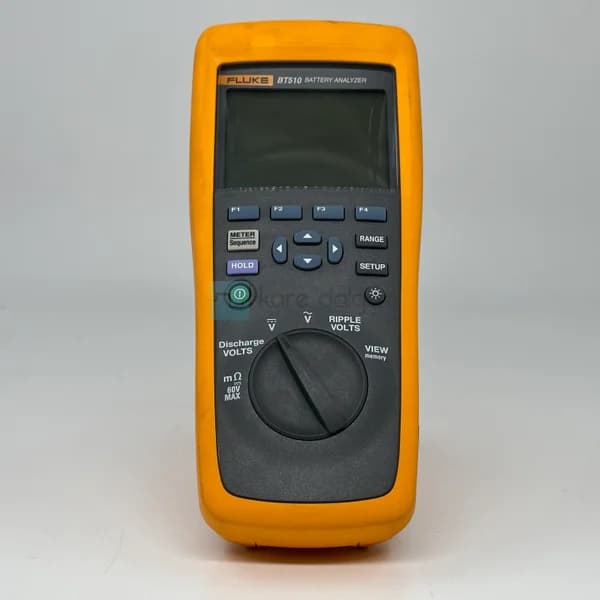
 A field-type battery test device records the internal resistance and voltage with a single touch. Explore: Fluke BT510 Battery Test Analyzer.
Why is battery internal resistance the most important health indicator?
A battery's internal resistance (the sum of ohmic resistance and polarization resistance) is the most direct electrical manifestation of electrochemical health. As a battery ages, processes such as plate corrosion, active material loss, electrolyte evaporation, and sulfation in lead-acid batteries increase the internal resistance. High internal resistance means that the battery drops more voltage under load and generates more heat inside.
In the field application, the reference value (baseline) is used: The measured internal resistance values are recorded when the battery group is new, and subsequent periodic measurements are compared with this baseline value. The generally accepted approach is that when the internal resistance increases by a significant amount (typically between 20% and 50%, according to the manufacturer's manual), the battery is suspect, and when it increases further, it is time to replace it. Because the exact threshold values vary depending on the battery chemistry, model, and manufacturer's documentation, these values must be confirmed with the manufacturer's data.
The greatest advantage of measuring internal resistance is that it can be done while the battery is in circulation (without the need for a discharge test). A full capacity discharge test provides the most accurate capacity information; however, it requires the battery to be taken out of service and takes time. Internal resistance trend monitoring, on the other hand, offers a practical and continuous monitoring balance between these two methods.
The increase in internal resistance is also valuable in the context of imbalance within the group. If the internal resistance of a single cell in a series-connected battery group rises significantly above that of the others, that cell carries an unbalanced load during both charging and discharging, which leads to local heating, faster degradation, and ultimately a weak point affecting the entire group. Therefore, values should be compared not only with absolute thresholds, but also with other batteries in the same group. Statistically, cells that deviate significantly from the average are often an early indicator of a problem, even before a visible voltage difference occurs.
What measurements does a battery analyzer perform?
A professional battery analyzer does not rely on a single parameter; it offers a set of measurements that assess battery health in multiple dimensions:
- Internal resistance/impedance: Measures ohmic resistance using a test current or an AC signal. It is a fundamental indicator of the health trend.
- DC voltage: For determining full/empty state and imbalance at the cell and group level.
- Ripple (waveform) voltage: Represents the AC component from the charge rectifier; high ripple shortens battery life.
- Temperature: Internal resistance is temperature-sensitive, so it is recorded for accurate evaluation; it also provides an early warning of thermal runaway.
- Discharge/capacity test: Advanced models verify the actual capacity (Ah) with controlled discharge.
Collecting these measurements together and systematically is much more valuable than a single reading. A single voltage reading can be misleading; however, a profile that evaluates voltage, internal resistance, and temperature together reveals the true state of the battery. Devices in the battery analyzer category are designed to collect these parameters quickly in the field.
 Advanced analyzers include ripple voltage and temperature measurements. Details: Fluke BT521 Battery Analyzer.
Correct measurement methodology: What to look for in the field?
Getting reliable data with a battery analyzer depends as much on the instrument itself as on the measurement discipline. The key principles to follow for consistent results are as follows:
- Contact quality: In internal resistance measurement, values are expressed in milli-ohms; a loose or oxidized contact renders the measurement completely invalid. Press the probe tips firmly against the clean terminal surface.
- Kelvin (4-digit) connection: The 4-digit method, which separates the cable and contact resistance from the measurement, is preferred for accurate internal resistance readings.
- Consistent measurement point: Take measurements from the same terminal point at each interval; otherwise, trend comparisons are invalidated.
- Temperature recording: Internal resistance varies with temperature, so always note the measurement temperature; if possible, make measurements under similar conditions.
- Charge status: Take measurements when the battery group is in a similar rest/charge condition.
- Safety: Battery groups have high short-circuit currents and acid risks; use properly categorized (CAT) insulated probe devices and personal protective equipment.
The ability to store data in the device memory and transfer it to software greatly facilitates periodic maintenance. Trend graphs reveal slow deterioration that is not visible to the eye and make change planning predictable.
Practical rule: A single measurement gives you only the snapshot of the moment; the true value is the trend over time of measurements taken under the same conditions. The essence of preventive maintenance is not to capture an absolute value, but to read a trend.
It is also important for reliable data to check the torque of the terminal screws, the condition of the cable lugs, and the output values of the charge rectifier before measurement. A loose connection creates a high impedance, even if the battery itself is robust, and the analyzer may report this incorrectly as a battery problem. Therefore, an abnormally high reading should always trigger a mechanical connection check before blaming the battery directly.
How to choose a battery analyzer?
The correct device selection depends on the scale of your application and the test requirements. When making a decision, consider the following criteria:
- Measurement range: The battery analyzer should cover the voltage range (single cell, 12 V block, or high-voltage string) and the expected internal resistance range that you will be monitoring.
- Measurement set: Is only internal resistance sufficient, or do you also need to measure ripple and advanced recording?
- Data management: Built-in memory, profile definition, limit setting, and reporting with PC software save time in large battery parks.
- Field durability: Temperature range, shock resistance, and safety classification (CAT rating) are critical for industrial environments.
- Calibration and traceability: The device's calibration must be traceable to ensure the reliability of measurements.
Model comparison according to need
The following table summarizes the difference between a basic field analyzer (e.g., Fluke BT510) and an advanced analyzer (e.g., Fluke BT521) in terms of typical features. For full technical values, refer to the product pages and the manufacturer's manual.
| Feature | Basic field analyzer (e.g., Fluke BT510) | Advanced analyzer (e.g., Fluke BT521) |
|---|---|---|
| Internal resistance measurement | Yes | Yes |
| DC voltage & temperature | Yes | Yes |
| Ripple voltage measurement | Limited / none | Yes |
| High-voltage string measurement | Basic scope | Extended scope |
| Typical use | Periodic maintenance, quick scan | Detailed fault analysis, reporting |
In practice; for routine periodic maintenance and quick weak-battery scanning Fluke BT510 such a field analyzer meets most needs. For critical infrastructures requiring ripple analysis, wider measurement range, and detailed reporting Fluke BT521 such an advanced model is more suitable. Both options are Fluke measurement devices.
Frequently Asked Questions
What is the difference between a multimeter and a battery analyzer?
A multimeter only shows the voltage at the terminals and does not provide information about the battery's behavior under load. A battery analyzer measures parameters such as internal resistance, ripple, and temperature to evaluate the battery's actual state of health (SoH). A weak battery that appears fully charged but has high internal resistance can only be detected with an analyzer.
How often should battery internal resistance be measured?
In critical UPS and telecom applications, intervals of six months or a year are usually preferred; however, the exact interval depends on the manufacturer's recommendation and the system's criticality level. What's important is to repeat measurements under the same conditions to establish a reliable trend.
Is it necessary to disconnect the battery from the circuit for internal resistance measurement?
No. Internal resistance (conductivity/impedance) measurement can be performed while the battery is in circuit; the greatest advantage of this method is that it does not interrupt the system. Only a full capacity discharge test requires temporarily taking the battery out of service.
Does high internal resistance always mean the battery needs to be replaced?
Not always. First, the reliability of the measurement (contact quality, temperature effect) must be verified. However, if there is a significant and permanent increase compared to the initial reference, the battery has weakened and should be planned for replacement. Threshold ratios vary depending on the battery model and manufacturer's data.
Summary and next step
The battery analyzer is a critical test device that converts the invisible aging of battery groups into measurable data, preventing unplanned outages. When combined with internal resistance trend tracking, ripple, and temperature measurement, it enables you to detect the weak cell before a fault occurs and makes your maintenance budget predictable. The correct device selection depends on the scale of your application and the required measurement set.
To determine the suitable device for your application you can review the models in the battery analyzer category, compare their technical specifications, and request a quote from Kare Dalga for the most suitable solution for your needs. You can contact us through the product pages for any questions you may have.