
What is a DC-DC Converter? Working Principle and Selection Guide
A DC input voltage converted to a different DC output voltage by a DC-DC converter, appears in almost every layer of modern electronics: from telecom cabinets to medical devices, from railway vehicles to industrial automation panels. In this article, we examine the working principle of a DC-DC converter, its topologies, critical parameters such as efficiency and isolation, and the criteria to consider when selecting the right module from an engineering perspective. Our goal is to clarify the meaning behind the numbers on the datasheet and help you safely select the suitable converter for your application.
What is a DC-DC Converter and How Does it Work?
A DC-DC converter is a power electronics circuit that converts a fixed or variable direct current input voltage to a stable DC output voltage required by the load. The basic logic is to temporarily store energy through a high-frequency switched transistor (MOSFET or IGBT) in an inductor and/or transformer and then transfer it to the output in a controlled manner. Therefore, modern modules are also referred to as "switched-mode power supply" (SMPS).
Unlike a classic linear regulator, a switched-mode converter does not convert the voltage difference into heat, but instead transfers the energy in packets. The result is much higher efficiency and smaller size. The most critical parameter that determines the behavior of a converter is the duty ratio (duty cycle): it expresses how long the switch remains on during a period and the feedback loop continuously adjusts this ratio to keep the output constant.
The switching frequency is also the backbone of the design. As the frequency increases, passive components such as inductors and capacitors decrease in size and power density increases; however, switching losses and electromagnetic interference (EMI) also tend to increase at the same rate. Therefore, in modern modules, a careful balance is sought between efficiency, EMI, and size. The stability of the feedback loop (loop stability) determines how quickly and overshoot-free the response to load steps is; in sensitive digital loads, this transient response performance is often more critical than the steady-state accuracy.
In practice, three basic modes of operation emerge:
- Buck (reducer): The output voltage is lower than the input. It is commonly used to obtain 5 V or 12 V from a 24 V source, for example.
- Boost (amplifier): The output voltage is higher than the input; typical in battery-powered systems.
- Buck-Boost / SEPIC: Maintains regulation when the input can be both below and above the output (for example, a discharging battery).
Kare DalgaThe DC-DC Converter categoryoffers a full range of these topologies, both in board-mount and chassis-mount industrial modules.
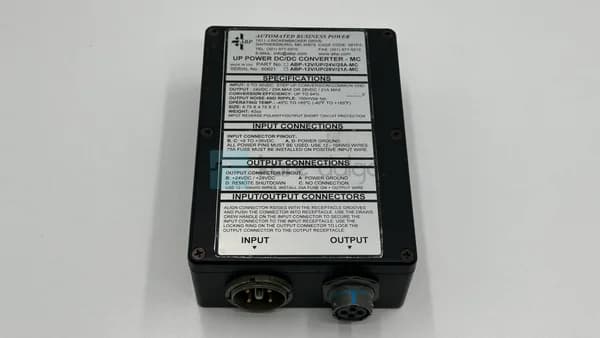
 A high-current-capable industrial DC-DC converter module: ABP 12V/UP/28V/21A-MC
DC-DC Converter Topologies and Isolation
When classifying a DC-DC converter, the most decisive distinction is whether there is galvanic isolation between the input and output. Non-isolated (non-isolated) topologies have the input and output share a common reference (ground); this approach is simpler, smaller, and usually more efficient. It is ideal for low voltage differences and point-of-load regulation on the same board.
Isolated (isolated) topologies, on the other hand, separate the input and output circuits with a transformer. This breaks ground loops, provides a safety barrier, and allows for safe energy transfer between different voltage references. Topologies like flyback, forward, push-pull, half-bridge, and full-bridge are preferred according to power level: flyback is an economical solution for low power, while full-bridge excels in applications of hundreds of watts and above.
The isolation voltage (e.g., 1500 VDC or 3000 VAC) must be checked in the datasheet; the minimum values specified by the relevant standards are binding for medical and railway applications. Isolation should be considered as a whole, not just as a voltage withstand value, but also including leakage current, insulation coordination (creepage/clearance), and test voltage (Hi-Pot). Artesyn and Astec industrial modules, for example, are designed for such critical applications with a wide input range and high isolation values.
Non-isolated topologies may not provide this safety barrier, but they offer advantages in Point-of-Load applications on the same board that power an FPGA, processor, or RF chain: fewer components, lower profile, and no transformer losses, usually resulting in a few percentage points higher efficiency. The right choice depends on whether a barrier is really needed; unnecessary isolation may enlarge and expensive the system without adding any benefit.
 Isolated, wide input range module: Artesyn RFB300-24S12-R5Y
How to Select a DC-DC Converter?
Selecting the correct converter is not just about matching the input and output voltages. From an engineering perspective, evaluating the following parameters in order can significantly reduce unexpected failures in the field:
- Input voltage range: Look at the nominal value as well as the minimum and maximum limits. In battery-powered or rail systems (e.g. 24V/110V bars), a wide input range of 2:1 or 4:1 is often required.
- Output voltage and regulation: Is it single output or dual/triple output? Load and line regulation percentages can be critical for precision analog circuits.
- Output power and current: In addition to continuous (steady-state) power, consider inrush and peak load demands. Leaving a 20-30% power margin (derating) extends the life.
- Efficiency: The efficiency curve at full load and partial load directly affects your thermal budget.
- Isolation requirements: If a safety barrier or noise separation is required, an isolated module is mandatory.
- Operating temperature: Examine the temperature derivation curve according to ambient temperature and cooling method (natural convection, baseplate, fan).
- Standards and certifications: Requirements such as EMC, safety (IEC 62368-1), medical (IEC 60601-1), or railway (EN 50155) narrow the product family.
For low-power requirements on the board modules like Astec ASA00BB18-L offer a compact solution, while in areas requiring higher current and system integration modules like BEL Power Solutions 0RSB-50R080 are preferred. In applications requiring multiple outputs triple-output modules like Artesyn NFC25-24T05-12 save board space by powering multiple rails with a single module.
 A multi-output converter powering multiple rails with a single module: Artesyn NFC25-24T05-12
Why is Efficiency and Thermal Management so Important?
90% efficient module, with a loss of approximately 11 W for a 100 W output, which is converted to heat. When efficiency drops to 85%, the loss increases almost twofold. Therefore, efficiency is not only about the energy bill; it is also about the temperature the module will reach, and thus its reliability and lifetime. The lifetime of electrolytic capacitors decreases by approximately half for every 10 °C increase in operating temperature. Choosing the right cooling method (heat sink, air flow, or heat sink plate) ensures that the module reliably delivers its full rated power.
Quick Comparison by Topology
The following table summarizes the key characteristics of the most common DC-DC topologies. Values are typical/nominal, and specific design decisions should be made from the product datasheet.
| Topology | Voltage Relationship | Isolation | Typical Power Range | Typical Application |
|---|---|---|---|---|
| Buck (Step-Down) | Vout < Vin | None | Low-Mid | Point-of-Load, on-board power supply |
| Boost (upconverter) | Voutput > Vinput | None | Low-Mid | Battery/accu powered systems |
| Buck-Boost/SEPIC | Voutput ≷ Vinput | None | Low | Variable input, portable devices |
| Flyback | Flexible | Fixed | Low | Auxiliary power supply, isolated multi-output |
| Forward / Half-Bridge | Flexible | Available | Medium | Industrial, telecom |
| Full-Bridge | Flexible | Available | High | High power, railway, telecom |
For those seeking isolated modules Astec ASA00CC18-L are a good starting point, while those who want to compare by brand ABP and BEL Power Solutions can review their portfolio from their pages.
Frequently Asked Questions
What is the difference between a DC-DC converter and a linear regulator?
A linear regulator dissipates excess voltage as heat, stabilizing the output and has lower efficiency depending on the input-output difference. A DC-DC converter, on the other hand, transfers energy by switching at high frequency, resulting in much higher efficiency (typically 85-95%) and less heat generated. If low power and low noise are critical, linear is preferred; if efficiency and power density are important, DC-DC is preferred.
Should I choose an isolated or non-isolated DC-DC converter?
If a safety barrier is required between the input and output, or if different voltage references or noise loops need to be broken, an isolated module is mandatory. In cases where the same card is used, with a common ground shared and only the voltage level needs to be changed, a non-isolated solution is smaller, cheaper, and more efficient.
Why should I examine the efficiency curve at different loads, not just at full load?
Most systems rarely operate at full load; the load varies continuously in real use. The efficiency of a module at partial load (e.g., 20-50%) reflects the average energy consumption and heat generation more accurately than the full load value. Therefore, it's necessary to look at the entire efficiency-load curve in the datasheet.
Should I select the output power according to my exact needs?
No. It is usually recommended to leave a margin of 20-30% (derating) above the continuous power requirement. This margin provides for inrush currents, temporary load increases, and power derating at high ambient temperatures, ensuring the module's long-term and stable operation.
Conclusion and Recommendation
The selection of a DC-DC converter is a comprehensive engineering decision that considers parameters such as input/output voltage, power, efficiency, isolation, and operating temperature. After determining the correct topology and sufficient power margin, focusing on a module family that meets the standard requirements of your application accelerates the process. As Kare Dalga, we have a wide range of stock, from low-power modules on board to high-current industrial units, from isolated and multi-output solutions to wide input range modules. You can explore our DC-DC Converter category to determine the most suitable model for your application or contact us for a quote tailored to your needs.