
The Right Partner in Industrial Electronic Component Supply
When a power module used in a card revision is declared "obsolete" by the supplier, a production line comes to a halt due to a single relay or DC-DC converter shortage, or when an incoming batch does not match the datasheet, every design and purchasing engineer knows the cost of lost time. The component procurement process is, in most projects, much more than just a cost item; it directly determines the product's time-to-market, field reliability, and the sustainability of long-life systems. In this article, we discuss the criteria to consider when working with an electronic component supplier, common mistakes made in the b2b supply chain, and how the right partner can make a difference, especially with obsolete or hard-to-find parts, from an engineering perspective.
Why is industrial component procurement a critical engineering decision?
The life cycle of many components used in industrial electronic designs is much shorter than that of the systems in which they are used. A railway vehicle, military system, or industrial control panel may last 15-25 years in the field, while the active life of a power module or RF transistor within that panel is often less than 7-10 years. This mismatch transforms the procurement decision from a simple "price comparison" exercise into a discipline of supply chain management.
The right supply decision encompasses a second source strategy in the design phase, consistent batch quality in the production phase, and the assurance of still being able to find parts years later in the maintenance and repair phase. The cost of having to redesign a card because you cannot find the same part three years after it was initially available at a reasonable price often outweighs the initial cost savings. Therefore, b2b electronic supply from the perspective of "total cost of ownership" (TCO) is more decisive than the unit price.
How to choose the right electronic component supplier?
When evaluating a supply partner, looking only at the breadth of the catalog can be misleading. The following criteria are the factors that make a difference, especially in industrial and long-lifetime applications:
- Product traceability and origin: The original manufacturer, part number, and, if possible, datasheet revision of the incoming part should be clear. Traceability is the first line of defense against the risk of counterfeit components, especially in the case of parts that have been discontinued from active production.
- Obsolete and hard-to-find part availability: A good supplier should be able to find not only current products, but also parts that have been discontinued but are still needed in the field. This is a capability that most standard distributors do not offer.
- Technical consulting: A partner that can provide equivalent (cross-reference) parts, comment on pin fit and electrical compatibility, acting as an extension of your engineering team.
- Category breadth and single-source supply: Getting a wide range of categories from a single supplier, from power modules to RF components, from relays to circuit breakers, simplifies the procurement process and reduces logistics costs.
- Consistency and delivery reliability: Staying true to the promised delivery time and batch quality is what truly sets a supplier apart, not in the prototyping phase but in series production.
At this point, Kare Dalga has DC-DC converter, RF transistor and relay and circuit breaker as a b2b supplier with categories combined, focuses on reducing the supply burden of engineering teams, especially in accessing increasingly hard-to-find industrial components.
 Traceability and consistent supply are key determinants in design-critical parts such as isolated DC-DC power modules. Example: Artesyn RFB300-24S12-R5Y DC-DC Converter.
What are the most common mistakes made in the b2b supply chain?
The most costly mistakes made between purchasing and design teams are often not technical, but process-related. The most common on the field are:
- Dependency on single source: Being dependent on only one supplier or one manufacturer part number (MPN) for a critical part can cripple a project when that source fails. At least one equivalent part should be defined during the design phase.
- Failure to follow life cycle alerts: When PCN (Product Change Notification) and EOL (End of Life) notifications issued by manufacturers are not followed, the part can suddenly become "unavailable." A proactive last-time buy strategy manages this risk.
- Focusing only on unit price: A low unit price, high minimum order quantity, long delivery time, or poor traceability can all lead to higher actual costs.
- Not verifying datasheet revisions: Pin layouts or temperature ranges can vary between different revisions of the same part number. It is essential to verify that the received part is the correct revision.
- Underestimating the risk of counterfeit components: The grey market, counterfeit, or re-labeled products pose a high risk, especially for obsolete parts. Traceable sourcing significantly reduces this risk.
What does having all power, RF, and electromechanical components from a single supplier bring?
In an industrial board, components from different disciplines are typically combined: power modules on the power side, RF components in the signal chain, and relays and circuit breakers on the switching and protection side. Managing these from different suppliers means separate orders, separate quality records, separate logistics, and separate accounting processes. Single-source supply reduces this burden and allows the engineer to focus on the core task of designing.
The table below summarizes the typical application areas and key considerations in supply for the major component categories in the Kare Dalga catalog:
| Component Category | Typical Application | Critical Point in Supply |
|---|---|---|
| DC-DC/AC-DC power module | Industrial power supply, insulation, rail | Insulation, efficiency, life cycle, and secondary resources |
| RF transistor and amplifier | Transmitters, radios, measurement systems | Frequency/power matching, obsolete part access |
| relay and circuit breaker | switching, protection, signal routing | contact life, actuation current, insulation voltage |
| Insulator and EMI filter | Galvanic isolation, EMC compliance | Standard compliance and consistent batch quality |
For example, in a high-current power supply design, a module such as the BEL Power Solutions 0RSB-50R080 DC-DC Converter may be preferred, while for more compact and low-power applications, the Computer Products (Artesyn) NFC25-24T05-12 DC-DC Converter may be more suitable. The fact that these parts can be sourced from the same catalog and purchased through the same process speeds up design iterations.
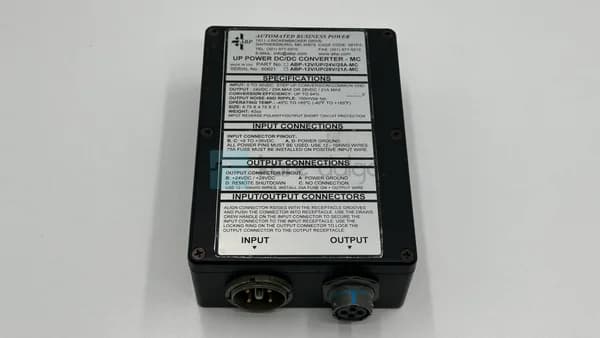
 Industrial power modules require years of spare parts availability in long-life systems. Example: ABP 12V/up/28V/21A-MC DC-DC Converter.
What does the right partner replace in obsolete and hard-to-find parts?
The most challenging area of industrial supply is the production of off-the-shelf parts. When a standard distribution channel responds with "out of stock," the system owner is usually left with three options: redesign the part, search for an alternative source, or cancel the project. The first option is both costly and time-consuming; the third is often unacceptable. This is where a supplier with a catalog that includes parts that are no longer commonly manufactured provides a decisive advantage.
The right partner not only finds the part, but also provides it from a traceable source, ensuring datasheet compliance and, when necessary, offering electrically equivalent alternatives. This approach extends the life of fielded systems and eliminates unnecessary redesign costs. The catalog structure of Kare Dalga's power electronics, RF, and electromechanical categories is designed to breathe new life into "parts that can't be found" scenarios for engineering teams.
A practical priority order that can be applied when an obsolete part is encountered allows for a much faster decision. First, the relevant component is searched for in any remaining traceable source, with the original manufacturer's part number, which is the lowest-risk method that requires no changes to the board. If it cannot be found, a pin-compatible and electrically equivalent (form-fit-function) alternative is evaluated. As a last resort, a minor board revision is considered; however, this option is often the most expensive, as it can trigger both validation tests and potentially certification processes. A good supply partner can speed up the first two steps on your behalf, eliminating the need for a board revision in most cases.
To facilitate searching by brand, the catalog can also be filtered by manufacturer; for example, Artesyn, Astec and ABP power electronics brands' products can be accessed directly. This saves time when searching for a specific MPN or its equivalent. The same approach applies when searching for a specific model, such as Astec ASA00BB18-L DC-DC Converter, for lower-profile power supply needs.
Frequently Asked Questions
What is the difference between an authorized distributor and a b2b component supplier?
An authorized distributor typically offers a limited portfolio contracted with specific manufacturers. Kare Dalga, on the other hand, is a b2b supplier that carries power, RF, and electromechanical components from various manufacturers in its catalog without being tied to a single brand. This structure provides a single-source procurement advantage, especially for multi-brand lists and hard-to-find parts.
Can I still find a component that has been discontinued from production?
In most cases, yes. Since the lifespan of industrial systems is longer than that of the components, demand for parts with ended active production continues. The Kare Dalga catalog focuses on access to such parts; for an unavailable MPN, traceable sources or electrical equivalent alternatives can be evaluated.
Is it correct to consider only the price when selecting a component?
No. Unit pricing alone is misleading; delivery time, minimum order quantity, traceability, and long-term access all factor into total cost. Especially in long-life industrial systems, the cost of not being able to find parts in the future can be much higher than the unit pricing difference.
Is it sensible to source components from different suppliers in different categories?
For many projects, yes. Sourcing power modules, RF components, and relays from a single supplier simplifies ordering, quality records, and logistics processes. This reduces procurement burden and allows the engineering team to focus more on design.
Summary and next steps
Industrial component supply decisions directly impact the speed, reliability, and long-term sustainability of your project. The right partner can ease the burden on design and procurement teams by providing traceable resources, a broad and multi-brand catalog, access to obsolete parts, and technical consulting. Avoiding single-source dependency, monitoring life cycle alerts, and keeping an eye on total cost of ownership are fundamental to a healthy supply strategy.
If you're looking for a power module, RF component, relay, or circuit breaker for your project, explore the Kare Dalga catalog. Explore our products in the DC-DC converter category, and if you can't find the part you're looking for or would like a suggested equivalent, contact us to request a quote; let our engineering team speed up your supply process.