
GSM and Network Test Equipment: Field Test Solutions
It is vital to be able to determine within minutes where a cable goes, where it breaks, or why signal quality drops at a base station in the field. GSM and network test devicescome into play at just this point: they provide fast and reliable diagnostics in the field, across a wide range of applications, from structural cabling to mobile network measurements. In this guide, we look at what a field test instrument does, which basic measurement types are available, how to select the right device, and how the GSM and Network Test solutions in the square wave catalogue translate into the field from an engineer's perspective.
The aim is to clarify how practical tools that can be carried in a bag, operated with one hand, and narrow down the problem at first glance, replace an expensive laboratory instrument. The right field test device reduces the hours spent on a fault call to minutes.
What is a field test device and which layers does it measure?
A field test device is a portable measurement instrument used to verify the physical and logical health of a transmission medium (copper cable, fiber, RF air interface) in the field. It is useful to think of these devices in three main layers according to their function:
- Physical layer verification: cable integrity, length, open/short circuit status, double pairing (wiremap), and the type of device at the end. This is the most time-consuming and fastest to resolve layer.
- Cable tracking and identification: Finding a single wire in a cable bundle, verifying the port matching on the panel. The toner and detector probe pair is standard for this task.
- Network/RF layer: Signal level, connection quality, cell identity, and excitation measurements in GSM/LTE fields. This layer typically requires specialized RF analyzers and mobile test sets.
In practice, a field team narrows the problem from top to bottom: first, whether the cable is in place, then whether it is connected to the correct port, and finally, whether the active network parameters are correct. A good field test strategy starts with the cheapest and fastest test.
What is the difference between GSM field testing and structural cable testing?
The two terms are often confused, but they solve different problems. GSM/mobile field testingdeals with the air interface: measuring signal strength (RSSI/RSRP), signal quality (RSRQ/SINR), cell identity, and neighbor cell lists around a base station or repeater. The goal here is to detect coverage gaps, excitation, and antenna pointing errors.
Structural cable testing aims to verify the integrity of the copper and fiber infrastructure inside buildings. Ethernet feed lines, grounding, and data cables leading to active equipment in a base station field require structural testing, because a significant portion of field problems lie in a poorly terminated cable or a loose connector, not in the RF side.
Therefore, a mature field team carries a set of equipment that covers both sides. The mobile measurement device tells the health of the signal "in the air", while the cable test device verifies the reliability of the "on-ground" infrastructure. The two measurements complement each other.
 A compact solution for field cable verification: Fluke Networks MicroScanner2 (MS2-100).
Cable tracing and identification: How does the toner and probe work?
One of the most repetitive tasks in field work is finding a single line in a crowded cable bundle or patch panel. The classic method is to connect a tone generator to one end of the cable and scan the other end with an inductive probe. The generator imposes a sound frequency on the line; the probe gives an audible/visual alert when it detects this signal.
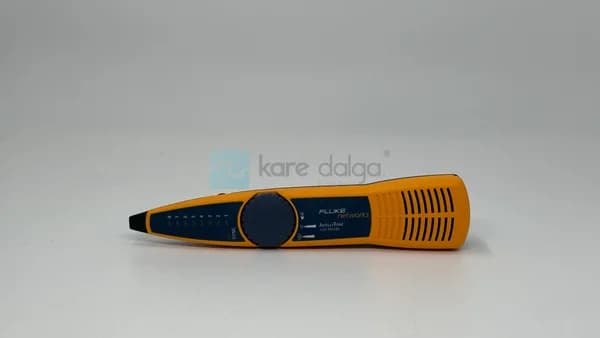
The biggest problem with traditional analog toners is that the signal "leaks" into adjacent cables: in a dense bundle, multiple cables tone at the same time, making it difficult to distinguish the correct line. Modern digital tone technologies are designed to reduce this confusion; they encode the signal to appear clearly only on the target line. In the Kare Dalga catalog, Fluke Networks IntelliTone 100 Probeis an example of a probe that facilitates line identification in crowded environments with this digital tone approach.
Things to consider when choosing the right toner-probe pair:
- Noise immunity: How well does the probe reject interference on active (live) lines? Digital tone has a significant advantage here compared to analog tone.
- Multi-environment support: The ability of the same device to work with both screened/unscreened copper and loose bundles.
- Field durability: One-handed use, visible/audible warning, and a robust body resistant to drops.
Field rule: Never start terminating or modifying a line without identifying it. Cutting the wrong cable can turn a one-day job into a week-long outage.
How to choose a field test device?
The right device choice depends on the type of field and the team's daily workflow. The following criteria provide a practical checklist for field test equipment offers a practical checklist for prioritization:
- Measurement scope: Do you only need cable tracing, or do you also require advanced verifications like wiremap, length, and port discovery (PoE/switch detection)? Features beyond your needs are a waste of budget.
- Usage speed: The device's boot time, single-touch testing, and readable screen directly impact efficiency for teams performing dozens of measurements daily.
- Durability and portability: IP class, shock resistance, battery life, and size that fits in a pocket or bag.
- Connector and media compatibility: Need for RJ45, coaxial, fiber adapters; support for screened cables.
- Reporting: The ability to record and transfer results is crucial for projects requiring documentation.
- Service and continuity: The sustainability of device calibration and spare accessories (probe tips, cables, batteries) procurement.
A single device does not meet all needs. For most teams, the most efficient approach is a fast cable verification device combined with a tone/probe set; this duo solves the majority of field outages without the need for RF equipment.
Typical field test device categories and uses
The following table summarizes the types of test devices commonly encountered in the field and the problems they solve. This provides a starting framework for planning your equipment set.
| Device type | Primary function | Typical use case | Primary problem solved |
|---|---|---|---|
| Power generator and probe | Cable tracking and identification | Patch panel, cable tray, distribution cabinet | Where does the cable go? |
| Cable verification device | Wiremap, length, open/short circuit | Structured cabling, Ethernet lines | Is the cable terminated correctly? |
| Network/port discovery tool | Switch, speed, and PoE detection | Active network points, outlets | Is the outlet live, and at what speed? |
| Mobile/RF field test set | Signal strength and quality measurement | GSM/LTE base station, coverage analysis | Where is the signal weakening? |
As you can see, the categories are not mutually exclusive, but complementary. In a base station field, cable and port-side verification is often performed first, followed by RF measurements.
 Digital tone monitoring in crowded bundles: Fluke Networks IntelliTone 100 Probe (Fluke).
Practical tips to improve field efficiency
Just as it is important to have the right device, it is also important to use it with the right workflow. Here are a few time-saving principles for the field:
- Top-down approach: Perform the fastest and cheapest tests first. Most faults are solved at the physical layer, without the need for expensive RF analysis.
- Take references: Measure and record a newly installed line. This will serve as a reference point when problems arise later.
- Work without disconnecting the connection: Prefer devices that can perform measurements without stopping the service on active networks; especially digital tone, live lines work more securely and clearly.
- Back up accessories: Consumables such as test probes, test cables, and batteries are the most common points of congestion in the field.
This discipline significantly reduces the average downtime in the field and reduces the need to go back to the same job twice.
Frequently Asked Questions
Is a GSM test device the same as a cable test device?
No. GSM/mobile test devices measure the signal strength and quality on the air interface; cable test devices verify the physical integrity of copper or fiber infrastructure. Both are usually needed in a base station field, as problems can occur on both the RF side and in cabling.
What is the difference between digital tone and analog tone?
Analog tone is susceptible to leakage of the signal into neighboring cables, which can lead to incorrect line selection in crowded bundles. Digital tone, on the other hand, encodes the signal so that it appears clearly only on the target line, making accurate identification easier in dense environments and live lines.
Can a cable verification device detect PoE or switch speed?
Some models can. Some cable verification devices can detect the active equipment at the end (switch port, PoE power supply) in addition to basic wiremap and length measurement. The actual scope varies by model; it is important to check the port discovery capabilities of the device before purchasing.
Is a single device sufficient for the field?
In most cases, no. The most efficient approach is to carry a fast cable verification device with a tone/probe set. This duo solves the majority of field faults that do not require RF measurement in one go; a separate RF test set is used for mobile coverage issues.
Summary and next step
Field test devices convert a fault call from the 'guessing' process to the 'measuring and deciding' process. The correct strategy is a workflow that starts from the physical layer and narrows down to the network layer, prioritizing fast and cheap testing. In practice, the ideal combination for most teams is a reliable cable verification device and a digital tone/probe set; this duo solves the majority of field problems without requiring RF equipment.
The Kare Dalga catalog offers compact and durable solutions for field teams: for clear line tracking in dense bundles, the Fluke Networks IntelliTone 100 Probe and for fast structural verification, the Fluke Networks MicroScanner2 (MS2-100). To determine the most suitable configuration for your field needs, you can GSM and Network Test products in the category, Fluke measurement equipment, and contact Kare Dalga to get a quote specific to your application.