
What is an Oscilloscope? A Guide to Bandwidth and Sampling Rate
oscilloscopeis a fundamental test and measurement device that makes the time-based changes in an electrical signal visible on a screen and is essential at every stage, from electronic design to field maintenance. While a multimeter gives you only an instantaneous value (voltage, current, resistance), an oscilloscope shows you the shape of the signal in time shows: rise time, jitter, noise, glitches, and timing relationships. In this article, we'll discuss what an oscillator is, and the two parameters that most influence the purchasing decision — bandwidth and Sample rate — we'll walk you through how to interpret it from an engineering perspective and how to choose the right device for your application.
Choosing the right oscillation frequency is much more subtle than the "more MHz is better" simplicity. A wrongly chosen bandwidth can distort your signal and mask the true error; insufficient sampling rate can create non-existent waveforms. You'll find these pitfalls and how to avoid them in the sections below.
What is an oscilloscope and how does it work?
An oscilloscope is a device that plots a graph on a horizontal axis showing time and on a vertical axis showing amplitude by sampling the input signal (in digital devices) or detecting the electron beam directly (in classic analog devices). On a typical screen, the horizontal axis is called time/division, the vertical axis is volts per division (volts/div) is set. These two controls "zoom" the signal horizontally or "scale" it vertically.
The vast majority of modern devices Digital Storage Oscilloscope (DSO) is a frame grabber. Here, the input is sampled by an analog-to-digital converter (ADC), the samples are stored in a fast memory (acquisition memory), and then reconstructed on the screen. Classic Analog oscilloscopes draw a signal in real time on a cathode ray tube (CRT); the stable, "live" image and high refresh rate of these devices are still valuable in some analog debugging scenarios.
Triggering: The Mechanism That Keeps the Image Stable
One of the most critical but least understood functions of an oscilloscope is triggering. Triggering tells the device when to "freeze" the waveform on the screen and start drawing it. Without proper triggering, even a periodic signal will remain frozen on the screen. The most common type of triggering is edge triggering (when a certain voltage threshold is crossed in either the rising or falling direction); more advanced devices offer pulse width, runt, pattern, and serial bus (I2C, SPI, CAN) triggering.
What is Bandwidth and Why is it Important?
Bandwidth is the upper limit of the frequency range that an oscillator can pass through without significantly weakening the signal. By definition, the amplitude of the input sine wave is reduced by -3 dB is the frequency at which the amplitude (approximately 70.7%) drops. In other words, if you apply a 100 MHz sine wave to a device with a 100 MHz bandwidth, the amplitude you see on the screen is about 30% below the actual value. This is why the bandwidth is the highest frequency you measure is equal to rather, it is distinctly high is required.
In practice, the common rule is that for accurate amplitude measurement, the highest meaningful frequency component of the signal should be at least 3 to 5 years The bandwidth setting is critical for signals with sharp edges, such as a square wave: a square wave contains a large number of high-order harmonics in addition to the fundamental frequency. An oscilloscope that cannot capture these harmonics will round off the sharp edges, hiding the actual rise time and possible overshoots.
A handy thumb rule: The fastest rise time a device can achieve is approximately Rise Time ≈ 0.35 / Bandwidth for bandwidth-limited devices (for Gaussian response input stages). For a 100 MHz device, this is approximately 3.5 nanoseconds.
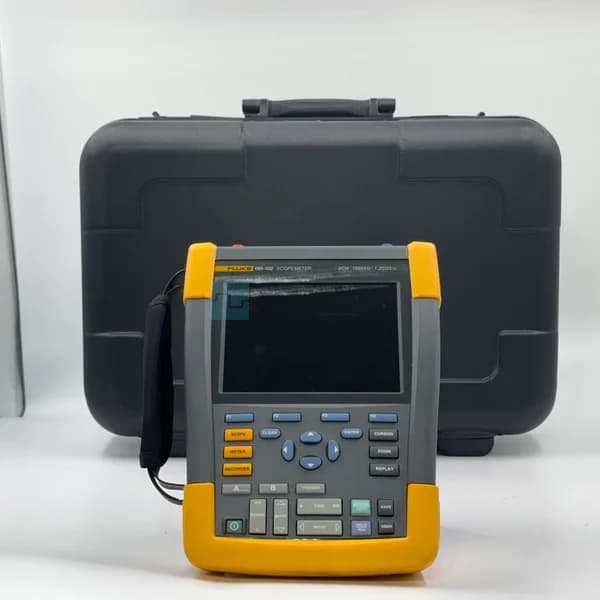
The classic 100 MHz class devices in the Kare Dalga catalog are good examples of this point. For example HP 54600B 2-Channel 100 MHz Oscilloscopeis a common reference point for digital design and general electronics laboratory work. For field use, Fluke 190-102 ScopeMeter portable oscilloscopeoffers the same 100 MHz class in an isolated, battery-powered package.
 Fluke 190-102 ScopeMeter: safe field measurements with isolated inputs and 100 MHz bandwidth. Explore the Product.
What is Sampling Rate? What is the Difference from Bandwidth?
Sampling rate is the number of times per second that a digital oscilloscope measures the instantaneous value of the input signal, and is typically expressed in units of megabits per second (Mbps), gigabits per second (Gbps), or million bits per second (Mbps). While bandwidth defines the frequency response of the analog front end, sampling rate defines the digital resolution. The two are different things and should be balanced.
According to the Nyquist theorem, the sampling rate must be at least twice the highest frequency in the signal to reproduce the signal. However, there is a significant difference between the theoretical minimum and practical reality: in the real world, to visually reliably see the waveform, the highest frequency must be at least 4 to 5 seconds of sampling is recommended. Otherwise, aliasing is likely to occur — the device displays a non-existent, low-frequency false waveform, which is one of the most difficult measurement errors to detect.
Real-Time and Equivalent-Time Sampling
There are two basic modes of sampling. Real-time samplingcaptures all points in a single pass and is required for non-repeating, single-shot events — for example, a transient glitch in a power supply. Equivalent-time sampling works only with repeating signals; the device artificially increases the apparent sampling rate by taking samples from consecutive periods. If you are chasing a one-time error, look for the "real-time" number in the catalog.
 HP 54600B: A classic lab DSO with a 100 MHz bandwidth and 20 MS/s sampling rate.
How to Choose Bandwidth and Sampling Rate Together?
When choosing an oscilloscope, it is a common mistake to evaluate these two parameters in isolation. A device with a high bandwidth but insufficient sampling rate will pass a high-frequency signal but cannot digitize it correctly; conversely, you will get fast samples but the analog front-end signal has already been attenuated. A balanced rule is that the real-time sampling rate should be at least 2.5 to 5 times the bandwidth.
The following table compares the basic parameters and typical use cases of digital and analog approaches:
| Feature | Digital Storage (DSO) | Analog (CRT) |
|---|---|---|
| Single-shot event capture | Possible (with real-time sampling) | No limited/permanent image |
| Signal storage/measurement | Stores on tape, automatic meter | Only live image |
| Aliasing risk | Var (at insufficient sampling rate) | No |
| Waveform update feel | Processing dependent | Extremely high, continuous |
| Typical use | Digital design, serial data path, recording | Fast analog error detection, training |
The reference devices of the classic analog world are still valuable today. Tektronix 465B 100 MHz analog oscilloscope and more compact Tektronix 453 50 MHz analog oscilloscope, with its real-time analog image without susceptibility control and aliasing risk, is frequently preferred for training and rapid fault detection. For these legendary devices and more, the Tektronix brand portfolio.
 Tektronix 465B offers real-time analog images without aliasing and intuitive controls.
Other Determinant Criteria
- Number of channels: Two channels are sufficient for most applications; if you are comparing timing relationships (such as time and data), more are required.
- Record length: Long memory allows you to maintain high sampling rates over long time windows.
- Vertical resolution (ADC bit count): 8 bits is common; higher resolution is advantageous for examining small signals on top of large ones.
- Prob and input isolation: Isolated inputs are critical for safety in network voltage or floating measurements.
Frequently Asked Questions
How wide should the bandwidth of an oscilloscope be?
The general rule is to choose a bandwidth that is 3 to 5 times the highest meaningful frequency component you are measuring. In the case of square wave or fast edge digital signals, keeping this ratio high prevents rounding of the edges and amplitude errors due to harmonics.
Should the sampling rate be higher than the bandwidth?
Yes. The real-time sampling rate should be typically 2.5 to 5 times the bandwidth in order to accurately digitize the signal. Insufficient sampling leads to aliasing and you see false waveform shapes on the screen.
Are analog oscilloscopes still used?
Yes. Analog oscilloscopes cannot store one-time events and do not perform automatic measurements, but they retain their value in training environments with fast analog error detection thanks to their real-time image without the risk of aliasing, high refresh rate, and intuitive controls.
What is the difference between a portable oscilloscope and a desktop one?
Portable (handheld) devices offer secure measurements in the field and energy environments with battery power supply and often isolated inputs. Desktop devices typically offer larger screens, more channels, and advanced triggering/analysis functions. The choice depends on whether the measurement is to be performed in the lab or in the field.
Summary and Getting to the Right Instrument
In the oscilloscope selection, bandwidth and sampling rate are two parameters that complement each other: bandwidth determines how faithfully the signal from the analog front end passes through, and sampling rate determines how accurately the signal is digitized. By choosing a bandwidth that is 3 to 5 times your highest frequency and a corresponding sufficient real-time sampling rate, you avoid both amplitude errors and aliasing. Don't forget to take into account your application (laboratory or field), the number of channels, the recording memory, and input isolation.
To evaluate the analog and digital options that best suit your needs in one place, visit products in the oscilloscope category can be viewed; Fluke and HP tag. If you would like to determine the most suitable combination of bandwidth and sampling rate for your application, or if you would like to receive a quote for devices in our catalog, simply contact the square wave team.