
Relay Types and Selection: Electromechanical, Vacuum and Solid State
When a signal or power needs to be switched in a circuit, the first question that often comes to mind for the engineer is "which relay?" Because the difference between relay types is not just about price, but about the lifespan of the circuit, switching speed, isolation level, and electromagnetic noise behavior. In this guide, we compare electromechanical, reed, mercury-wetted, vacuum, and solid state (SSR) relays from an engineering perspective; relay selection step by step, we discuss the parameters you should look at. The goal is to enable you to correctly read the numbers on the datasheet and determine the most suitable switching element for your application from the start.
A relay is basically a switch that opens and closes a circuit with a control signal from another circuit. The common point is this; the point where they differ is how they actuate the contact and in which physical environment they perform the switching. This difference determines all types of relays. how they
What is a relay and what are the basic parameters to select one?
A relay is an electrically isolated switch that switches a high-power load with a low-power signal applied to its coil (or control input in the case of an SSR). In a classic electromechanical relay, the current flowing through the coil creates a magnetic field, which attracts an iron armature, thus closing or opening the contacts. Galvanic isolation is born right here: the control side and the load side are physically separate.
When selecting a relay, the basic parameters you should definitely check on the datasheet are as follows:
- Coil voltage and power: Nominal values such as 5 V, 6 V, 12 V, 24 V; must be compatible with the current that your driver circuit can supply.
- Contact configuration: NO (normally open), NC (normally closed), SPDT/DPDT, etc. Form A has a single NO contact, Form B has a single NC contact, and Form C has a single bipolar double-acting contact.
- Switching capacity: The maximum voltage and current that the contact can safely carry. Resistive loads and inductive loads have different values; if this distinction is ignored, the contact will burn out prematurely.
- Switching speed: The time required to pull (operate) and release (release) the contact, measured in milliseconds.
- Mechanical and electrical life: The number of millions of cycles it can withstand. Mechanical life is measured at no load, and electrical life is measured at load.
- Insulation resistance: Dielectric withstand voltage (kV) between the coil and the contact.
These parameters are balanced differently in each relay family you will see later. The fast ones carry low current, the slow ones carry high current; the high voltage ones insulate more. The correct choice is to set these compromises according to your application.
Electromechanical relays: the most common and versatile choice
The electromechanical relay (EMR) is the most common switching element in the industry. It stands out with its wide voltage and current range, low cost, and virtually zero leakage current when closed. Since the open contact is a true air (or gas) gap, insulation is near perfect in the closed state, which makes them attractive for safety isolation functions.
When the coil is energized, the switch moves and the contacts make mechanical contact. This mechanical movement is also a weakness of EMR: contact bounce, arc formation, and limited cycle life. In inductive loads (motors, contactor coils, solenoids), the arc formed at the moment of switching wears out the contacts over time. Therefore, in inductive loads, suppressing the arc with a snubber or freewheeling diode significantly extends the life. For general industrial control, PLC outputs, and power distribution, EMR remains the default choice.
Where are reed and mercury-immersed relays used?
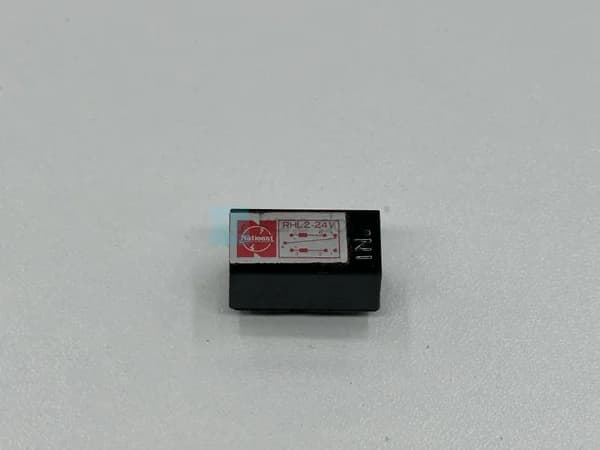
 Reed relays provide fast and clean switching with their hermetically sealed contacts in a glass tube. Example: National RHL2-24V Reed Relay.
A reed relay is a design where two ferromagnetic contact leaves are hermetically sealed in a glass tube filled with an inert gas (usually nitrogen). When the coil generates a magnetic field, the leaves bend towards each other to make contact. The hermetic seal prevents the contacts from oxidizing and protects them from dust and moisture, giving reed relays very high insulation resistance and low, stable contact resistance.
The strongest aspects of reed relays are their high switching speed (usually a few hundred microseconds to milliseconds), low coil power, and long mechanical life. Their small bodies make them indispensable in test and measurement devices, automatic test equipment (ATE) matrix switching, medical devices, and sensitive signal paths. For compact applications, Elfein 802-1G9-6V miniature reed relay like small-body models are preferred, while in places where different coil voltages are required, Elfein 802-1R17-18V relay like 18V options come into play.
Mercury-wetted reed relays
Mercury-wetted reed relay, a special type of reed relay where the contact surfaces are coated with a thin film of mercury. The mercury film renews the contact at each switching; thereby, contact bounce practically disappears. "Bounce-free" switching is of critical importance in applications requiring precise timing, high repeatability, and a clean pulse; for example, high-speed counters, time measurement circuits, and low-level signal switching.
 Mercury-wetted reed relays provide bounce-free switching. Example: C.P. Clare MRMD-15053.
An important limitation of these relays is their mounting position: most models must be mounted vertically within a specific angle range in order for the mercury film to spread evenly over the contacts. Different contact/voltage variants from the same family, such as the C.P. Clare MRMD-15130 and miniature versions such as the C.P. Clare MRME-15003 MicroClareed relay are ideal for designers seeking repeatable results in measurement and instrumentation circuits. The full range of reed and mercury-soaked types is available from C.P. Clare, National and Elfein brand portfolios.
Vacuum relays and solid state relays: two solutions for the ends
At one end of the spectrum, there are vacuum relays designed for high voltage and RF, and at the other end, there are solid state relays (SSR) with no moving parts.
The vacuum relay, is a special relay with contacts placed in a ceramic or glass envelope under high vacuum. The vacuum offers much higher dielectric strength compared to air; therefore, vacuum relays can safely insulate voltages of kilovolt order with a small contact gap. Their arc extinguishing capabilities and low capacitances make them ideal for RF power switching, antenna tuning, transmitter systems, and high voltage test setups. You can find this special group vacuum relay in a separate category.
Solid State Relay (SSR) uses a semiconductor switch (TRIAC, MOSFET or thyristor) instead of a mechanical contact and typically isolates the control and load sides with an optocoupler. Since there are no moving parts, the SSR is silent, has no contact wear, and can switch on and off very quickly at high cycle rates. On the other hand, there is a voltage drop across it during transmission and heat is generated, so it often requires a heatsink; also, there is a small leakage current when closed and it does not provide true galvanic isolation. Frequently switched resistive heaters, lighting, and fast control loops are the natural application area of SSR.
Relay Types Comparison Table
The table below summarizes the typical behavior of five major relay families. Values reflect general trends; for final selection, always rely on the datasheet values of the relevant product.
| relay Type | Switching Speed | Typical Current/voltage | Lifetime (cycle) | Primary Usage |
|---|---|---|---|---|
| Electromechanical (EMR) | Medium (ms) | High current, medium voltage | Medium | General industrial control |
| Reed relay | Fast (µs–ms) | Low current, medium voltage | High | Test/measurement, signal switching |
| Mercury wetted reed | Fast, non-leaping | Low to medium current | Very high | Precise timing, instrumentation |
| Vacuum roller | Medium | High voltage (kV), RF | High | RF power, transmitter, high voltage |
| Solid state (SSR) | Ultra-fast | Medium current, heat limited | Extremely high | Frequent switching, silent operation |
Frequently Asked Questions
What is the main difference between a reed relay and an electromechanical relay?
In a reed relay, the contacts are sealed in a glass tube filled with an inert gas and are directly actuated by a magnetic field; therefore, they are very fast, clean, and long-lasting, but carry low currents. In an electromechanical relay, the armature mechanism can switch higher currents, but the speed is lower and contact wear is greater.
Why is a mercury-dipped relay considered to be bounce-free?
The contact surfaces are coated with a thin layer of mercury, which re-wets the surface with each contact. This results in a stable, single-pulse closure instead of the mechanical bouncing seen in conventional contacts. This feature ensures repeatability in applications requiring precise timing and low-level signal measurement.
Can a solid state relay replace an electromechanical relay in every application?
No. SSRs are very fast and silent, do not suffer from mechanical wear; however, they produce heat in transmission, may require a heat sink, and have a small leakage current when closed. In cases where true galvanic isolation or low loss at high current is required, electromechanical relays are still more suitable.
What type of relay is preferred for high voltage or RF switching?
In these applications, vacuum relays come to the forefront. The high dielectric strength of vacuum enables the insulation of kilovolt-level voltages with a small contact gap and the switching of RF power with low capacitance. Antenna tuning and transmitter systems are typical examples of this.
Summary and getting the right relay
Relay selection is not reduced to a single "best" answer; it depends on the application's current, voltage, speed, insulation, and lifetime requirements. In general industrial switching, electromechanical relays, reed and mercury-immersed relays in high-precision and high-speed signal paths, vacuum relays in high-voltage RF, and solid-state relays in frequent and quiet switching stand out. When you match the contact structure, switching capacity, and lifetime values in the datasheet with your application, the right choice becomes obvious.
In the Square Wave catalog, you can find reed, mercury-wetted, and miniature relay varieties under one roof. To compare the model suitable for your project and get a quote, check out our Relay & Circuit Breaker category; evaluate the options in our Vacuum Relay category for your high voltage and RF needs. If you cannot find the part number you are looking for, you can contact our engineering team to determine the most suitable switching element for your application together.