
What is SDR/USRP? Software Defined Radio Applications
Software Defined Radio (SDR)is an RF architecture that offloads much of the processing done in traditional radio architecture, such as modulation, demodulation, filtering, and frequency conversion, to software. In this article, we will take a look at what an SDR is, how platforms like the USRP work, their key parameters (sampling bandwidth, ADC bit depth, number of channels, phase alignment), and their application areas ranging from the lab to 5G test rigs from an engineering perspective. Our goal is to clarify the criteria to consider when selecting the right SDR/USRP platform and provide a solid framework for how to set up your measurement chain.
What is Software Defined Radio (SDR)?
In a classical receiver, channel selection, intermediate frequency (IF) filtering, and demodulation are performed with separate hardware blocks. An SDR, on the other hand, digitizes the signal as early as possible and performs all subsequent processing with software on an FPGA, DSP, or general-purpose processor. In practice, a typical SDR receiver chain looks like this: antenna, low-noise amplifier (LNA), an RF front-end (frequency mixer/convertor), band-pass filter, followed by an analog-to-digital converter (ADC). In the case of a digital signal, the process starts in reverse, with a DAC.
The power of this architecture lies in its flexibility: with the same hardware, you can decode FM broadcasts, capture GSM frames, and transmit your own custom waveform. All you need to do to change the waveform is to update the software, rather than replacing the card. In this way, SDR provides an ideal platform for rapid prototyping, protocol research, and verification of communication systems.
The basis of SDR is IQ sampling The signal is represented in a complex number plane, separated into two components, in-phase (I) and quadrature-phase (Q), thus preserving amplitude and phase information. Complex sampling allows you to distinguish negative and positive frequencies within the same Nyquist limit, thus making efficient use of the band. All processing, such as modulation, demodulation, channel filtering, and frequency shifting, is performed numerically on this IQ stream. From an engineering perspective, this means that the hardware front end is only responsible for producing a clean, linear, and low-noise IQ stream; all signal processing intelligence resides in the software.
How do USRP and SDR Platforms Work?
USRP (Universal Software Radio Peripheral) is a family of hardware that has become a de facto reference in the SDR ecosystem. A typical USRP consists of two layers: a replaceable RF front-end (daughterboard) that moves the signal from the antenna end into the appropriate frequency band, an ADC that samples the signal, digital down-conversion (DDC) and demodulation within the FPGA, and then the samples are transferred to the host computer via USB, Gigabit Ethernet, 10 GbE, or PCIe.
Here, the concept of criticism is an example of the flow rateof the instantaneous bandwidth. As your instantaneous bandwidth increases, the amount of IQ samples that need to be transferred per unit time also increases, which directly determines the choice of interface. While USB may be sufficient for an application running at a few MHz, hundreds or even thousands of MHz of instantaneous bandwidth and multi-channel scenarios require a high-performance data path such as PCIe. In multi-channel designs, phase coherence is a key consideration: if you are going to do beamforming, MIMO, or DoA estimation, all channels must be fed with a common clock and reference.
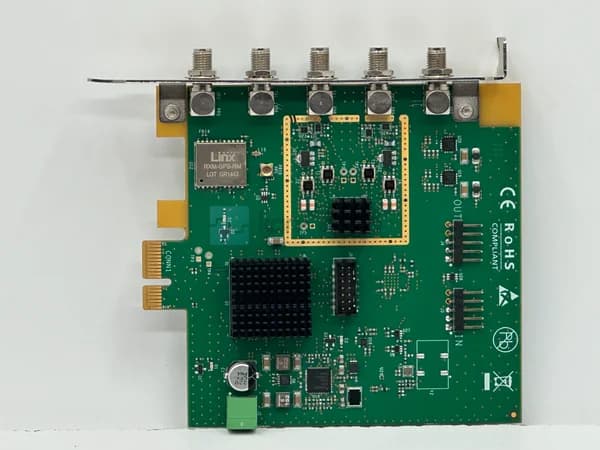
 An SDR transceiver example with PCIe interface and 4x4 MIMO support: Amari PCIe SDR 100 4x4, designed for test scenarios that require high instantaneous bandwidth.
On the software side, tools like GNU Radio, UHD/USRP drivers, and MATLAB/Simulink are prevalent. On the cellular test and protocol validation side, Amarisoft like software stacks can turn SDR hardware into a complete 4G/5G base station or UE emulator, enabling end-to-end scenario setup in a laboratory environment. Cards offering high channel count and PCIe connectivity (e.g., Amari PCIe SDR 100 4x4) are a natural choice for such solutions.
Which Technical Parameters are Important in SDR?
The following headings directly determine the performance when evaluating an SDR/USRP platform:
- Frequency range (tuning range): The band covered by the front end; it can range from HF to several GHz. Your application's band (e.g., ISM, cellular, aviation) must fall within this range.
- Instantaneous bandwidth: The width of the frequency window that can be observed at a given time. This is critical for wideband signal acquisition and spread spectrum analysis.
- ADC/DAC resolution: Bit depth determines the dynamic range; each additional bit theoretically provides approximately 6 dB of SNR. High bit depth is important for separating weak signals from strong ones.
- Number of channels and phase coherence: For MIMO, beamforming, and DoA, multiple channels and deterministic phase relationships between channels are required.
- Reference clock stability: The internal TCXO may not be sufficient; a GPSDO or external 10 MHz reference is preferred for frequency accuracy and long-term stability.
- Data sheet: USB, 1/10 GbE, PCIe — determines the sustained sample rate and latency.
All of these parameters are interrelated. For example, increasing the instantaneous bandwidth increases the ADC sampling rate and thus the data path load; going to multiple channels, however, creates additional requirements on both the interface and clock distribution side.
A practical calculation illustrates this dependency. In a complex (IQ) example, you can roughly estimate the raw data rate as sample rate x bit depth x number of channels x 2 (I and Q). For example, transmitting 100 MS/s of samples from four channels at 16-bit resolution represents tens of gigabits of raw data per second in uncompressed form, which explains why PCIe or 10 GbE are required instead of USB or 1 GbE. Deduplication and DDC applied within the FPGA reduce the amount of samples transferred to the host by filtering only the band of interest to you. Therefore, answering the question "how much bandwidth is really needed?" at the outset directly affects both cost and system stability.
Another frequently overlooked issue is front-end linearity. When a strong input signal brings the LNA or mixer close to saturation, intermodulation products (IP2/IP3) are generated, resulting in false peaks in the spectrum. In spectrum monitoring applications that require a high dynamic range, it is as important to properly adjust the front-end gain and input attenuator as it is to fully utilize the bit depth of the ADC.
Comparison: SDR/USRP vs. Classical Spectrum/Network Analyzer
SDR is a flexible development and emulation platform; for calibrated, traceable measurements, laboratory instruments come into play. The two are not competitors, but complementary:
| Criteria | SDR/USRP | VNA/Spectrum Analyzer |
|---|---|---|
| Primary purpose | Waveform development, emulation, protocol testing | Traceable, calibrated RF measurements |
| Touch-sensitive | Reprogrammable with software | Fixed measurement functions, high accuracy |
| Typical output | IQ sample stream, special signals | S parameters, spectrum/power measurement |
| Measurement accuracy | Application/calibration dependent | Factory calibrated, traceable |
| Typical use | 5G/IoT prototype, signal intelligence, R&D | Component characterization, suitability testing |
Practical healthy RF test benches include both: producing the waveform with SDR and verifying it with a calibrated analyzer on the other side. RF network analyzers in the category of devices take on the task of reference verification of SDR-based setups with S-parameter and spectrum measurements.
 For calibrated reference measurements, Rohde & Schwarz ZVL-13: completes SDR setups as both VNA and spectrum analyzer.
SDR/USRP Application Areas
The range of applications for software-defined radio is quite broad. Key highlights include:
- Cellular testing and emulation: 4G/5G base station (gNodeB) and device (UE) emulation, call/session testing, network stack validation. Amarisoft based solutions are widely used in this area.
- Signal intelligence and spectrum monitoring: Wideband scanning, detection and classification of unknown broadcasts.
- Radar and DoA: Angle-of-arrival measurement and passive radar experiments with multi-channel, phase-matched architectures.
- IoT and special communications: R&D and compatibility testing of protocols such as LoRa, Zigbee.
- Education and research: A flexible laboratory platform for hands-on courses ranging from modulation theory to channel coding.
In many of these applications, SDR hardware alone is not sufficient; it must be considered in conjunction with an RF chain consisting of the correct antenna, LNA, filter, and reference clock. In multi-channel scenarios, the platform's high-band interface, such as PCIe, and its external reference input are crucial.
Frequently Asked Questions
What is the difference between an SDR and an USRP?
SDR refers to a general radio architecture where signal processing is done in software. The USRP is a common hardware implementation of this architecture; it consists of a modifiable RF front end and an FPGA-based main board. Thus, every USRP is an SDR, but not every SDR is a USRP.
What instantaneous bandwidth is sufficient for SDR?
This depends entirely on the application. While narrowband digital communication may be satisfied with a few MHz, 5G NR carriers or wideband spectrum monitoring may require tens or even hundreds of MHz. As the instantaneous bandwidth is increased, the load on the data interface and processor also increases, so selecting more than you need will introduce cost and complexity.
Is additional equipment required to validate SDR output?
If you are targeting a measurable measurement, then yes. SDR is a flexible production/emulation platform, but it cannot measure power and S-parameters with the accuracy of a factory-calibrated VNA or spectrum analyzer. Therefore, SDR setups are typically used in conjunction with a reference analyzer.
What should I look for in a multi-channel (MIMO) application?
The most critical factor is inter-channel phase coherence. For beamforming, MIMO, and DoA, all channels must be synchronized with a common clock and reference. In addition, the high number of channels results in a high total sampling rate, making a wideband data bus such as PCIe practically necessary.
Conclusion: Choosing the Right SDR/USRP Platform
SDR/USRP, due to its flexibility, provides a strong foundation in a wide range of areas, including R&D, cellular testing, spectrum monitoring, and education. The right choice depends on the balance of frequency range, instantaneous bandwidth, ADC resolution, number of channels, and phase coherence, as well as the reference clock and data interface according to your application. On the emulation and development side multi-channel PCIe SDR platforms, and on the calibration validation side VNA/spectrum analyzers complement each other.
If you want to clarify the suitable configuration for your project you can review the products in the SDR/USRP category and the options for RF network analyzer for reference measurement and get a quote from Kare Dalga for the hardware that suits your needs.