
Traco Power Power Modules: Industrial DC-DC and AC-DC Solutions
From industrial control panels to railway systems, and from medical devices to communication infrastructure, the reliability of the power conversion layer determines the lifespan of the entire system. Traco Power power modules are one of the first names engineers look for in catalogs, precisely at this point: a compact PCB-mount structure, a wide input range, and certified isolation performance all come together. In this article, we discuss how Traco Power DC-DC and AC-DC modules work from a supply and design perspective, how their product families are differentiated, and which parameters to pay attention to when selecting the right module. Our goal is not to make a sale, but to help you base your Traco Power module selection on solid engineering reasons.
What are Traco Power Modules and Why are They Preferred?
Traco Power is a Swiss-based manufacturer specializing in board-mounted isolated and non-isolated converters, external AC-DC power supplies, and DIN rail power modules. The distinctive feature of its product portfolio is the offering of modules with industrial-grade ruggedness and standard pinout in small power classes (typically from 1 W to several hundred W). This standardization enables an engineer to upgrade a converter in an existing design to a different output voltage or power class without changing the board layout.
A practical Traco Power DC-DC converterswitches the input voltage at high frequency, transfers power through a transformer or inductor, and produces regulated or semi-regulated output voltage. The galvanic barrier between the input and output in isolated modules breaks up noise loops and provides safety isolation. These modules allow you to transfer the EMC, thermal, and reliability risks associated with designing a raw switching power supply to a validated and certified component. That's why modules in the DC-DC Converter category are a favorite among teams aiming for rapid market introduction.
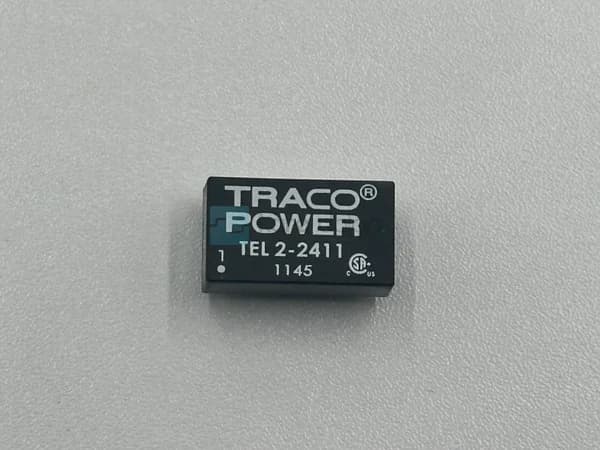
 Designed for top-mount installation Traco Power TEL2-2411 isolated DC-DC converter.
What are the differences between the TEL, TEN and TMP series?
Traco Power's naming convention makes it easy to understand the module's power class and rating. Typically, the first letter of the series indicates the family, and the following number indicates the nominal power level (watts). Below you can find a practical distinction of the most commonly encountered series:
- TEL series: Small, high-efficiency (typically 1-6 W range), isolated DC-DC modules with a 2:1 input range. They come in compact packages such as SIP/DIP and are ideal for powering signal circuits and low-power subsystems.
- TEN series: Isolated modules with regulated output, providing higher power (typically 10-30 W range). Variants with the "WI" suffix typically offer a 4:1 ultra-wide input range, which is important for industrial applications requiring battery-backed or wide voltage tolerance.
- TMP series: AC-DC top power supplies; they produce DC directly from the mains voltage and are used for compact designs that do not require an external power supply. Therefore, they are evaluated under the AC-DC Converter category.
Decoding the code in a model such as the TEN20-2411WI clearly illustrates this principle: the "TEN" series, "20" for approximately 20 W of power, "24" for the nominal input voltage (24 V class, wide range), "11" for a single output class, and "WI" for a 4:1 ultra-wide input range. Once you recognize this systematic coding, you can read the basic characteristics of the module from the part number you see in the catalog to a large extent.
 4:1 ultra-wide input range in the Traco Power TEN 20-2411WI 20 W class module.
Comparison of Series
The following table summarizes typical characteristics of example Traco Power modules in the square wave catalog. For exact values, always refer to the data sheet for the relevant model; the bands in the table are for guidance purposes.
| Model | Tip | Tipic Power Strip | Input Range (approx.) | Isolation |
|---|---|---|---|---|
| TEL2-2411 | Isolated DC-DC | ~2 W | 2:1 (18-36 V class) | Available |
| TEL5-2422 | Isolated DC-DC (dual output) | ~5 W | 2:1 (18-36 V class) | Available |
| TEN 20-2422WIN | Isolated DC-DC (dual output) | ~20 W | 4:1 (9-36 V class) | Available |
| TEN20-2422 | Isolated DC-DC (dual output) | ~20 W | 2:1 (18-36 V class) | Available |
| TEN30-2412 | Isolated DC-DC | ~30 W | 2:1 (18-36 V class) | Yes |
How to Choose the Right Traco Power Module?
Module selection involves much more than just matching the output voltage. The following steps provide a practical checklist for a reliable working design in the field:
- Determine the input voltage profile. Is the power nominal, or is it coming from a bar/battery? In battery-supported systems with risk of transient overvoltage, 4:1 input range "WI" variants provide a wider safety margin. If powered from a fixed and regulated bar, a 2:1 range is sufficient and usually more efficient.
- Specify the number and voltage of the output. Do you need a single output or a symmetrical dual output (such as ±15 V) for an op-amp and analog supply? Dual output models such as the TEL5-2422 are useful for analog signal chains.
- Calculate the actual load power and rated current. Instead of operating the module at full capacity continuously, target a load of typically 70-80% for thermal derating.
- Select the insulation voltage according to safety requirements. While basic insulation is sufficient for signal isolation, reinforced insulation and compliance with relevant standards are required in applications accessible to humans.
- Understand the regulation behavior. Some low-power isolated modules are "unregulated" structures optimized for fixed loads; if the load is highly variable, choose a regulated TEN series.
The primary advantage of an isolated architecture is that it breaks ground loops and does not allow potential differences between input and output. If isolation is not required and you only need high-efficiency voltage reduction, non-isolated point-of-load (POL) solutions can be more compact; in this case, it also makes sense to compare the wide Traco Power portfolio and other brands.
EMC, Thermal Management and Reliability: What Matters in the Field?
The "efficiency 90%" line on the data sheet is not sufficient on its own. Real-world performance is defined by three axes:
EMC and Conducted Noise
Switching modules inherently generate wideband noise. Many Traco Power modules meet certain classes of EMC standards with built-in filtering; however, to meet stringent limits such as CISPR/EN class B at the system level, an additional EMI filter and a balanced PCB layout are often required. The placement of input and output capacitors directly affects common mode noise.
Thermal Derating
Each module has a maximum operating temperature and a derating curve applied as this temperature is approached. In enclosed housings where convection cooling is limited, operating the module below its nominal power significantly extends its lifetime. TEN30-2412 such as 30 W class modules, thermal path planning is critical at high ambient temperatures.
Reliability and Lifetime
The module's MTBF value and operating temperature range are decisive in applications with long lifetime expectations, such as industrial and railway. WI variants like TEN 20-2422WIN, with a wide operating range, have been positioned with consideration for such demanding environments. On the AC-DC side, in AC-DC Converter modules, protection against network transient overvoltages (surge) must be completed at the system level. As a practical rule, the notes on the input capacitor and startup behavior on the module's data sheet should not be overlooked; especially in applications where high capacitive loads are driven, the behavior of startup current (inrush) and overload protection prevents unexpected surprises during the first startup in the field.
 30 W power class requires thermal path planning for high ambient temperatures Traco Power TEN30-2412.
Frequently Asked Questions
What is the difference between designing your own switching power supply with Traco Power modules?
A ready-made module is a pre-tested, certified component that has already passed electromagnetic compatibility, isolation, and thermal validation. While designing your own may provide a lower unit cost, it shifts the burden of validation, certification, and reliability risks to you. Using a module is often the most cost-effective approach for medium-volume projects with fast time-to-market requirements.
What do the "WI" and "WIN" suffixes mean?
These suffixes typically denote an ultra-wide 4:1 input voltage range. This allows a single module to be used in both 12 V and 24 V class systems, simplifying inventory. In battery-backed and voltage-fluctuating bars, this wide range provides a safety margin.
Do I always need to use an isolated DC-DC module?
No. Isolation is required when it is necessary to break ground loops, create a safety barrier, or separate different reference potentials. Non-isolated solutions can be more efficient and compact in simple voltage reduction applications that share a single reference ground and do not require safety isolation.
In what case are dual output (±) modules logical?
TEN20-2422 -like symmetric dual output modules are ideal for layers requiring ±voltage, such as op-amp based analog signal processing, sensor interfaces, and measurement circuits. It eliminates the complexity of generating virtual ground with a single supply.
Summary and Next Step
Traco Power power modules offer a mature response to industrial DC-DC and AC-DC conversion needs with standardized pinout, wide input range options, and certified isolation performance. To select the right module, it is necessary to evaluate the input profile, output configuration, actual load power, isolation requirement, and thermal rating together; considering the system context is the healthiest approach rather than making a decision by looking at a single data sheet line. If you have decided on the suitable series for your project, DC-DC Converter and AC-DC Converter in our categories, you can Traco Power modules; you can compare options ranging from small powerful models like TEL2-2411 to 30 W class. You can get a quote and support from the Kare Dalga team for stock status, alternative equivalents, or project-based technical evaluation. TEL2-2411 to 30 W. For stock availability, alternative equivalents, or project-based technical evaluations, you can get quotes and support from the square wave team.