
What is a Vacuum Relay? High Voltage and RF Applications
In harsh applications such as high-voltage switching, RF transmitter circuits, and antenna tuner systems, conventional electromechanical contacts quickly become inadequate due to arcing (back) and contact wear. This is where the vacuum relay comes into play: by keeping the contacts in a high-vacuum glass or ceramic enclosure instead of air, it enables the safe switching of voltages ranging from hundreds of volts to tens of kilovolts. In this article, we will examine the working principle of the vacuum relay, its critical advantages in high-voltage and RF applications, selection criteria, and what to consider in engineering design.
In this guide for the engineer reader, our goal is to show in concrete terms which parameters are truly decisive when selecting the right component. We will also discuss the different types of vacuum tubes available in the square wave catalog in the context of their application.
What is a Vacuum Tube and How Does It Work?
A vacuum tube is a switching element in which the moving and fixed contacts are placed in a hermetic enclosure at high vacuum (typically at the 10⁻⁶ mbar level). Since there are almost no gas molecules in the environment surrounding the contacts that can ionize, the arc that forms when the contacts are opened extinguishes much faster and the dielectric withstand is several orders of magnitude higher than that of conventional air-gapped contacts.
The operating principle is basically electromechanical: when a coil is energized, the resulting magnetic field attracts the moving armature, closing (or opening, depending on configuration) the contacts within the vacuum envelope. When the coil voltage is removed, the spring force returns the contacts to their initial position. What makes the difference is that the switching takes place in a vacuum environment; this allows for much higher voltage and RF power levels to be handled in the same physical size.
 The Kilovac KC-11 vacuum relay, designed for high-voltage applications , is an example of a device that uses this principle..
The fact that the vacuum chamber is typically made of ceramic or borosilicate glass is no coincidence: these materials provide both high dielectric strength and resistance to heat and mechanical stress generated when contacts open. The seal of the chamber must be maintained throughout the life of the relay; failure of the vacuum leads to a sudden drop in performance.
What are the Advantages of Vacuum Relays in High Voltage and RF?
The advantages that distinguish vacuum relays from standard electromechanical or solid-state alternatives become apparent, particularly in the high voltage and high frequency domain:
- High dielectric strength: The vacuum environment allows for very high breakdown voltage even at small contact gaps. This means compact kilovolt-level switching.
- Low contact resistance and low inductance: Short contact paths and proper enclosure geometry minimize RF losses, which is critical for high-frequency VSWR and insertion loss.
- Back burn rate: Since there is no gas to ionize, the back burns very quickly, reducing the risk of contact erosion and arcing.
- Long mechanical and electrical life: The hermetic design eliminates contact oxidation and the effects of external contaminants.
- Wide temperature range: The vacuum cell, being largely isolated from ambient conditions, operates stably even in challenging thermal conditions.
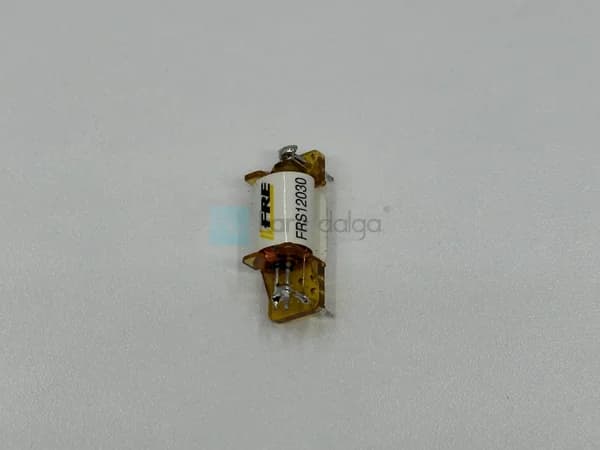
In RF transmitter circuits, antenna switching matrices, and impedance matching tuners, these features directly impact system performance. For example FR Electronics / Cynergy3 FRS12030 RF relay, is an example designed for low-loss switching in RF signal paths. For heavier high-voltage tasks, solutions like Jennings RJ4B-26N1018 high-voltage vacuum relay are preferred.
Where are Vacuum Tubes Used?
Typical applications include: AM/FM and shortwave transmitters, amateur radio linear amplifiers, antenna tuner and switch systems, plasma and semiconductor manufacturing equipment, high-voltage test fixtures, X-ray and medical imaging devices, laser power supplies, and electrostatic applications. The common thread is the need to reliably switch high voltage or high RF power in each application.
 RF signal paths for low-loss switching FR Electronics / Cynergy3 FRS12030 RF relay.
The common requirement of these applications is not only high voltage, but also repetitive and low-loss switching. For example, in an antenna tuner, the relay is expected to maintain the same VSWR performance with each impedance change; even a small loss at the transmitter output can result in heat of the order of watts, reducing efficiency and creating thermal problems. Therefore, the selection of a vacuum relay should be considered together with the rest of the RF chain in the system.
Types of Vacuum Relays and Comparison
Vacuum relays vary according to contact configuration, voltage class, and application target. The following table compares vacuum relays with similar switching elements from an engineering perspective.
| Property | Vacuum Relay | Standard Electromechanical Relay | Reed Relay |
|---|---|---|---|
| Switching environment | High vacuum | Air/atmosphere | Inert gas-filled glass tube |
| Typical voltage range | Hundreds of V – dozens of kV | Low-to-mid voltage | Low voltage, precision signal |
| RF Compatibility | Very High | Limited | Medium (Low Power) |
| Bearing strength | Excellent | Average | Low |
| Typical current capacity | High (RF/HV) | Medium-high | Low |
| Size/Power Ratio | Compact | Large | Very Small |
The low-power reed relays seen in the table are still indispensable in sensitive signal switching. For example, National RHL2-24V reed relay or C.P. Clare MRMD-15053 mercury-wetted reed relay, contact bounce is prominent in unwanted measurement and signal circuits. However, when high voltage and high RF power are involved, none of them can replace the vacuum relay. To evaluate all switching elements together, we recommend checking the Relay & Switch category.
 High voltage switching for Jennings RJ4B-26N1018 vacuum relay.
How to Choose a Vacuum Relay? Critical Parameters
Selecting the right vacuum relay requires more than just looking at the "high voltage" rating. Systematically evaluate the following parameters in your design:
- Test (stand-off) voltage: The maximum voltage that the roller can withstand with contacts open. Consider the peak voltage of your application, transient overvoltages, and safety margins together.
- Continuous current capacity: For RF applications, look at the effective (RMS) current; for DC/AC switching, look at the continuous load current. Cooling conditions directly affect capacity.
- RF power and frequency range: Losses at the operating frequency, contact inductance, and enclosure geometry determine the VSWR. Low loss is required at high frequencies.
- Contact configuration: Select a form such as SPST (NO/NC), SPDT that matches your switching topology.
- Coil voltage and power: The coil voltage (e.g., 12V, 24V, 26V) and pull-in current that your driver circuit can provide must be compatible.
- Mechanical/electrical life: The expected number of switching cycles; hot switching significantly reduces life expectancy.
- Installation and thermal management: The cooling surface, installation type, and ambient temperature determine the degree of derating you will achieve in the real world.
Especially hot switching (switching under load) and cold switching (switching without load) distinction, is the most critical factor determining the lifespan. If possible, design the sequencing to switch at the moment the RF or load energy is turned off. In medium voltage class applications, Kilovac K47B-04 vacuum relay like models offer a balanced choice, while for higher voltage requirements, Kilovac KC-11 can be preferred.
Why Derating and Safety Margin are Important?
The maximum values provided by the manufacturer are based on ideal laboratory conditions. In real-world applications, humidity, contamination, altitude, vibration, and temperature can reduce these values. General engineering practice is to leave a solid margin of safety for both voltage and current, which ensures both reliability and long-term durability. Keep in mind that even a small deviation at high voltage can lead to catastrophic arcing and permanent damage.
In systems operating at particularly high altitudes, the dielectric strength of the air gaps outside the enclosure may decrease, requiring re-evaluation of creepage and clearance distances. Although the interior of the vacuum tube is not affected, the risk of surface flashover on the outer surface between the terminals of the relay may increase. Similarly, the addition of snubbers or clamping elements to limit transient overvoltages during switching extends the life of both the relay and the surrounding components.
Frequently Asked Questions
What is the difference between a vacuum relay and a reed relay?
The reed relay uses magnetic contacts in a small glass tube filled with inert gas and is ideal for low-voltage, sensitive signal switching. The vacuum relay, on the other hand, can switch much higher voltage and RF power by keeping the contacts in a high vacuum. In short: reed for sensitive/low power, vacuum relay for high voltage/RF.
Why are vacuum relays preferred in RF applications?
The vacuum environment, short contact paths, and low-inductance construction provide low insertion loss and good VSWR at high frequencies. Additionally, the risk of arcing is much lower at high RF powers. Therefore, they have become standard in transmitters, antenna tuners, and switch matrices.
Can vacuum relays switch safely under load (hot switching)?
It can be done to a limited extent, but hot switching accelerates contact erosion and significantly shortens life. The best practice is to design a timing (sequencing) that performs switching when the load or RF power is turned off. This maximizes both life and reliability.
How long is the life of a vacuum tube?
Life varies over a very wide range, depending on switching conditions. High cycle counts can be achieved with cold switching, while heavy hot switching significantly reduces life. You must evaluate the mechanical and electrical cycle values provided by the manufacturer in conjunction with your own load profile.
Summarize and Find the Right Vacuum Tube
Vacuum relays are a compact yet powerful solution that offers superior dielectric strength, low loss, and long life in high voltage and RF switching applications. For the right choice, consider test voltage, current capacity, RF performance, contact configuration, coil requirements, and thermal conditions together; be sure to consider the hot/cold switching distinction and safety margin. Vacuum relay solutions such as Jennings and Kilovac address different needs, with reed relays suitable for sensitive signal circuits and heavy-duty high-voltage applications.
To compare the suitable model for your project and review the technical details, you can browse our Vacuum Relay products, or request a quote from the Square Wave team to assess the voltage and RF requirements of your application together. The correct component selection directly determines the reliability and lifespan of your system.