
How to Choose a Digital Multimeter? True-RMS, Accuracy, and CAT Rating
Choosing the right digital multimeter goes far beyond the reliability of your measurement results; it also directly affects your safety while working. When choosing from dozens of models on the market, three technical concepts come into play that change everything: true RMS measurement capability, the accuracy specification of the device, and the CAT measurement category based on IEC 61010 standard. In this article, we take a deep dive into these three criteria from an engineer's perspective, explain which features are critical in which situations when choosing a digital multimeter, and show you step by step how to determine the right device for your application.
What is a Digital Multimeter and What Ranges Does It Measure?
A digital multimeter (DMM) is a basic test and measurement tool that measures a wide range of electrical quantities, including voltage, current, and resistance, in a single device. It converts the input signal into a digital form using an analog-to-digital converter (ADC) and displays the result directly as numbers on the screen. This eliminates parallax error, improves reading accuracy, and enables advanced functions such as data logging.
A modern DMM typically includes the following functions in addition to basic measurements:
- AC/DC voltage and current measurement
- Resistance, continuity and diode test
- Capacitance and frequency measurement
- Min/Max recording, average and peak capture
- In some models, temperature (thermocouple) and mA loop (4-20 mA) measurements
The functions you need depend on the area you work in. A simple and rugged device is sufficient for field service, while high resolution and low uncertainty are important in R&D laboratories. You can review models for different use cases under the multimeter category You can view models for different usage scenarios below.
What is a True-RMS multimeter and why is it important?
True-RMS (true root mean square) is a measurement method that accurately measures the effective (RMS) value of an AC signal, independent of its waveform. To understand why this is important, consider how inexpensive multimeters work: average-responding devices take the average of the rectified signal and scale it to RMS only assuming a pure sine wave. As long as the signal is pure sine, the result is correct.
However, in modern installations, current and voltage waveforms rarely produce clean sine waves. Variable speed drives (VFDs), switched-mode power supplies, LED drivers, dimmers, and electronic ballasts generate significant harmonic distortion. In these distorted waveforms, an average-response device True-RMS multimetercan result in measurement errors of up to 40% compared to ye, leading to incorrect fault diagnosis, incorrect sizing, and security vulnerabilities.
Crest Factor and True-RMS Limits
When selecting a True-RMS device, it's not enough to just look for the "True-RMS" label; you also need to check the device's crest factor specification. The crest factor is the ratio of the peak value to the RMS value (approximately 1.414 for a pure sine wave). This ratio increases for pulsed, square wave shapes. If the device's crest factor capacity is low, errors will still occur with high-peak signals. For robust field work, models that support a crest factor of 3 and above are typically preferred.
 Fluke 115 True-RMS Digital Multimeter — provides accurate effective value readings in field signals containing harmonics.
If you're not doing motor control, automation, HVAC, or general electrical maintenance today, True-RMS is a must in practice. For simple tasks that only work with clean mains voltage and resistive loads, an average-responding device may still be an economical option; however, for most professionals, True-RMS is the right starting point. Models like the Fluke 79 III offer this capability in a cost-effective package.
What is the Difference Between Accuracy, Resolution, and Count?
Among multimeter features, the most frequently confused concepts are accuracy, resolution, and count. Each refers to different things and only together do they describe the device's actual performance.
- Accuracy: This is how close the read value is to the true value. For DMMs, it is usually expressed as "± (percentage of reading + lowest number of digits)", for example ± (0.5% + 2 dgt). The "dgt" (digit) here adds a fixed uncertainty and can be a major source of error, especially at low readings.
- Resolution: This is the smallest change that the device can distinguish. High resolution allows you to see small changes, but does not guarantee accuracy on its own.
- Count: The maximum value that the display can show. A 6000-count device displays up to 6000, while a 50000-count device offers much finer resolution over the same range. The "digit" expression (e.g., 3¾ digit) is a similar representation.
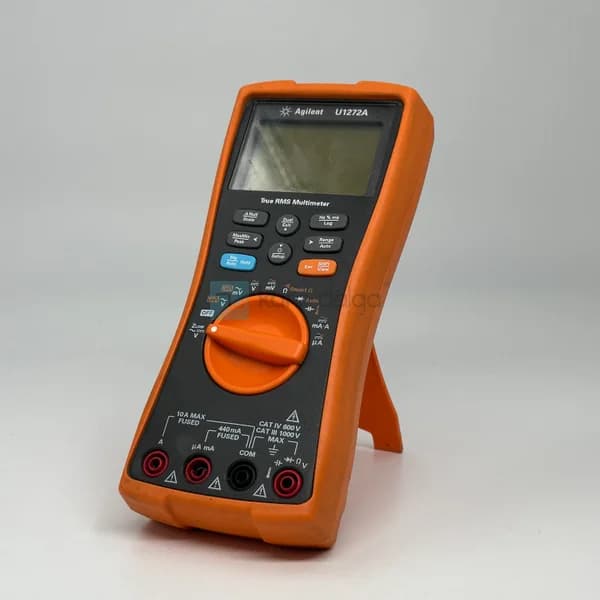
For laboratory and calibration work, high count and tight accuracy specifications are important. Agilent U1272A -like 30000-count handheld devices combine field portability with near-lab-grade resolution. In contrast, a rugged and easy-to-read model like the Fluke 15B meets most requirements for general maintenance.
 Agilent U1272A — suitable for sensitive diagnosis with high count and wide measurement range.
What is CAT Rating (Measurement Category) and How to Choose It?
The CAT rating is a safety category based on IEC/EN 61010 that determines in which type of electrical environment a multimeter can be safely used. The hazard is not only the voltage level at the point, but also the energy of transient overvoltages at that point. As you get closer to the source of the electrical distribution, the short-circuit current and transient energy increase; therefore, the CAT level increases.
The CAT rating must always be read in conjunction with a voltage value. For example, a CAT III 600 V device may have a higher transient withstand than a CAT II 1000 V device, because the test pulse energy is much greater at the higher category for the same voltage.
| Category | Typical Application Area | Example Measurement Points |
|---|---|---|
| CAT I | Non-networked, protected electronic circuits | Device internal cards, low-power signal circuits |
| CAT II | Single-phase loads with fuses | Appliances, home/office equipment, portable tools |
| CAT III | Fixed installation and distribution | Panel-mounted bars, motor control centres, short-distance supply lines |
| CAT IV | Network entry and service feed point | Main circuit before switch, meter, and external line connections |
Practical rule: The CAT level of your device should be equal to or higher than the highest energy point you work with. For a technician working inside a panel, at least CAT III is required, and CAT IV is required for someone who comes into contact with the grid input side. Using a cheap CAT II device inside a panel poses a serious hazard due to the risk of arc flash. The measurement tips (probes) and the device's CAT label is at the same level as; the weakest link in the chain is the determining factor.
Designed for industrial field and panel applications Fluke 77 IV With models like this, durable enclosures, and appropriate CAT ratings, they are a safe choice for these environments.
Application-Specific Multimeter Selection: Which Features Stand Out?
To clarify your needs, avoid spending money on unnecessary features, and prevent missing a critical capability. Let's examine a few typical scenarios.
Field service and general electrical maintenance
Durability, IP protection class, True-RMS, wide voltage range, and a clear, readable display are priorities. The continuity test's fast and loud feedback is valuable for quick diagnosis in the field.
Process and instrumentation
Features like 4-20 mA loop measurement, even loop power and temperature measurement are critical. Fluke 787 -like process multimeters simplify field calibration tasks significantly by combining a multimeter and loop calibrator in one unit.
 Fluke 787 — a multimeter and loop power supply combined into a process measurement device.
Electronic design and R&D
High resolution, low uncertainty, capacitance/frequency measurement and data recording become crucial. Here, the count value and accuracy specification become the determining difference between models.
Brand consistency should also not be overlooked: the availability of spare probes, cases, and accessories can affect business continuity in the long term. That is why many professionals set equipment standards around brands with extensive ecosystems, such as Fluke form equipment standards around brands with a wide ecosystem like
Frequently Asked Questions
What is the difference between a True-RMS multimeter and a normal multimeter?
A normal (average-response) multimeter calculates AC values only assuming a pure sine wave. A True-RMS multimeter, on the other hand, accurately measures the true effective value even when the waveform is distorted. In environments with drives, switching power supplies, and electronic loads, non-True-RMS devices can produce significant measurement errors.
What is the difference between CAT III and CAT IV?
CAT IV is for locations where the highest transient energy is present, such as the mains inlet; CAT III covers fixed installations at panel and distribution levels. CAT IV devices are designed to withstand higher shock energy. You should select a category that is appropriate for, or higher than, the highest energy level at which you will be working.
How many counts are sufficient for a multimeter?
6000 counts are sufficient for general maintenance. For precise measurements, monitoring of small changes, or laboratory work, 20,000 counts or more are preferred. Counts determine the resolution, but accuracy should be evaluated in conjunction with the specification.
Does multimeter accuracy vary with measurement?
Yes. Since accuracy is usually given as "percentage of reading + fixed count", the fixed count term increases the relative error as the measured value decreases. Therefore, it is crucial to select the appropriate range for low-level measurements and check the device's specifications for that range. Additionally, periodic calibration is required to maintain accuracy.
Result: Choosing the Right Multimeter
In summary, three criteria are decisive in selecting a digital multimeter: True-RMS for accurate reading in distorted waveforms, sufficient accuracy and count value to trust your results, and a CAT rating suitable for your work environment. When you match these three to your application, you get a device that is neither over- nor under-featured, safe, and long-lasting. There is a different balance point for every scenario, from field service to process measurement, and from general maintenance to R&D.
As a square wave in our catalog Fluke 115, Fluke 77 IV and Agilent U1272A are among the many models available for different needs. You can browse our multimeter category to find the most suitable device for your application, or contact us to get a quote based on your technical requirements.