
Fluke Multimeter Models: Which Fluke is Right for You?
When it comes to Fluke multimeters, what usually comes to mind is not just a single device, but a wide range of products that span from the field to the laboratory, from simple continuity testing to sensitive process calibration. Choosing the right model depends not so much on the budget, but on where and what you will be measuring with the device. In this guide we take a practical look at the main classes of the Fluke multimeter family, what the model numbers mean, and which device makes sense in which engineering scenario. Our goal is not to impose a specific model on you, but to provide a clear framework so you can match criteria such as True-RMS, accuracy class, CAT safety category, and special functions with your application.
Whether you are a maintenance technician or a design engineer working in an R&D laboratory, within the multimeter category it is possible to find the right device that will not bother you for at least a few years. The distinctive feature of the Fluke portfolio is that the model numbers are positioned according to specific user profiles; when you understand this logic, the choice becomes quite easy.
What do Fluke multimeter model numbers mean?
Fluke's model numbering is not random; it roughly indicates the device's target audience and level of capability. Knowing this logic is the fastest way to eliminate the correct one from dozens of models.
- 10/15 series (e.g. 15B): Entry-level, basic use. Designed for training, simple electrical maintenance, and general-purpose measurements. True-RMS is not usually available; linear (average-responding) measurements are made.
- 70 series (e.g. 77 IV, 79 III): Classic "general purpose" electrician/technician multimeters. They offer robustness, readability, and sufficient accuracy balance. Higher models such as the 79 include True-RMS.
- 110 series (e.g. 115): Compact, field-ready, True-RMS devices. Single-hand operation and portability are the primary concerns.
- 170 series: Professional-grade, high-resolution, and advanced features (e.g. temperature, frequency, min/max).
- 180 series and 87V: Top-of-the-line "industrial" reference models. Known for features such as high accuracy, wideband True-RMS, low-pass filter in motor drive (VFD) environments. The 87V is the model that many engineers consider the "gold standard."
- 700 series (e.g. 787): hybrid devices combining a multimeter and a process calibrator; can perform 4-20 mA loop measurement and simulation.
You can find many representatives of these series in our catalog. For example, for entry-level Fluke 15B, as a classic technician model Fluke 77 IV, and for field users who want True-RMS Fluke 115 are highlighted.
 Compact and featuring True-RMS Fluke 115, it is a well-balanced choice for field maintenance.
Why is True-RMS so important?
When selecting a Fluke model, one of the most critical distinctions you will encounter is whether the device True-RMS (true effective value) measurement is performed. An average-responding multimeter assumes that the measured waveform is a pure sine wave and scales the result accordingly. However, in modern facilities, current and voltage waves are often not pure sine waves.
Frequency inverters (VFD), switched-mode power supplies, LED drivers, dimmers, and electronic ballasts; distort the current waveform and produce high harmonic content. In such an environment, an average-responding device can misread the true effective value by 10% to 40%. A True-RMS device, on the other hand, provides the correct effective value regardless of the waveform; this enables you to make accurate decisions in protection element sizing, heat calculation, and energy measurement.
Practical rule: True-RMS is required everywhere for non-linear loads (motor driver, UPS, electronic lighting). If you only work with resistive loads (classic heater, incandescent lamp), an average-responding device may also be sufficient.
Another point to consider in True-RMS devices is crest factor and measurement bandwidth. In waveforms with high harmonics, transient peak values can be very large; if the device's crest factor capacity is insufficient, it will clip these peaks and still provide incorrect readings. Similarly, if the frequency components of the signal you are measuring exceed the True-RMS bandwidth of the device, accuracy decreases. Therefore, it is not enough to just look for "True-RMS"; also consider the bandwidth and peak values required by your application.
Our catalog features True-RMS models such as Fluke 79 III and Fluke 115, while high-end models like the 87V are designed for wide bandwidth True-RMS and VFD environments. For a maintenance team on a budget seeking True-RMS, the 79 III offers a sensible middle ground.
Depending on the usage scenario, Fluke models
The right choice is made based on the job profile, not the "most expensive is best" mentality. The table below is a simplified decision guide that matches typical user profiles with Fluke series. Since final specifications may vary depending on the model variant, we recommend relying on the technical data on the product pages.
| User/Task | Feature Requirement | Recommended Fluke Class |
|---|---|---|
| Education, hobby, simple maintenance | Basic V/A/Ω, robustness, low cost | 15B/10-15 series |
| General field engineer | Durability, continuity, capacity, temperature | 77 IV/70 series |
| HVAC, electronics, lighting, small motors | True-RMS, compact body | 115/79 III |
| Industrial R&D and precision measurement | High accuracy, wideband True-RMS, VFD filter | 87V/180 series |
| Process and instrumentation engineer | 4-20 mA loop measurement + simulation | 787/700 series |
For field and general maintenance
In daily electrical maintenance, durability and readability are valuable down to the last decimal place. The Fluke 77 IV, a current representative of the field-proven 70 series for over a decade, is a practical choice for technicians with its drop-proof design, clear display, and wide measurement range.
For process and loop testing
In the world of instrumentation, a multimeter alone is not enough; often, both measurement and simulation are required in a 4-20 mA current loop. At this point, Fluke 787 -like multimeter-calibrator hybrid devices collect two separate instruments in one body, lightening the field case. Designed for tasks such as testing transmitters, validating valve positions, and providing loop power, the ability to drive the loop without external power supply eliminates the hassle of carrying a separate power supply in the field; this is a significant convenience when energizing PLC and DCS input cards.
 The multimeter and process calibrator combination Fluke 787, is a practical hybrid for instrumentation engineers.
How are accuracy, resolution, and CAT safety class evaluated?
After determining the model series, comparing the three technical parameters simplifies the selection:
- Accuracy: Usually expressed as "± (%reading + count)". A low percentage and a low count indicate greater accuracy. For laboratory reference, the accuracy of the 87V/180 series is sufficient for most applications; for field use, the accuracy of the 70/110 series is sufficient.
- Resolution (counts): A 6000-count display shows 0 to 600 V in 0.1 V increments. Higher 20000-count models provide finer resolution. Higher counts are advantageous for capturing trends and small changes.
- CAT safety category: CAT II, CAT III, and CAT IV, indicating the energy environment in which the device can be safely used and the transient overvoltage it can withstand. If you are working in panelboards and distribution lines, choose a CAT III or CAT IV rated device that is suitable for your measurement point; this is not a matter of convenience, but of personal safety.
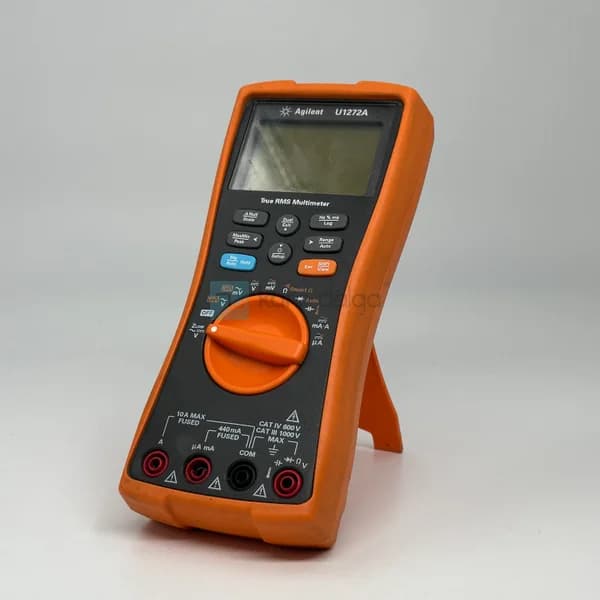
For users seeking True-RMS, high resolution, and advanced recording capabilities, our catalog includes the U1272A True-RMS Digital Multimeter, which are useful in the R&D lab with their wide measurement range and data recording capabilities. You can view the current list of all models on the multimeter category You can review it from the page.
Frequently Asked Questions
Why is the Fluke 87V recommended so often?
The Fluke 87V is considered an industry benchmark because it combines high accuracy, wide bandwidth True-RMS measurement, and features such as a low-pass filter designed for VFD environments in one device. It is a versatile choice for engineers who require both laboratory precision and field ruggedness. If your budget allows and you want a single "do-it-all" device, it makes sense.
Is it a mistake to buy a non-True-RMS Fluke?
No, it depends on the application. If you're working only with resistive loads and clean sine waves, an average-responding model (such as the 15B) is sufficient and economical. However, if you're likely to encounter non-linear loads like motor drives, UPS, or electronic lighting, choosing a True-RMS model helps you avoid measurement errors.
What is the difference between a multimeter and a calibrator?
A multimeter measures a quantity (reads it); a calibrator generates a known reference signal (source). Hybrid instruments such as the Fluke 787 combine both: they measure current and also provide 4-20 mA simulation, allowing you to work with a single instrument for transmitter and loop testing. For pure process calibration, a separate calibrator may be preferred.
Which CAT class should I choose?
The CAT class is determined by the possible transient overvoltages at the point of measurement. CAT II is required for panel-level and in-device measurements, CAT III for distribution panels, and CAT IV for main entry and outdoor line connections. Always use a device that is equal to or higher than the class required by your measurement point.
Summary and finding the right model
Selecting the right Fluke multimeter, understanding the model number, and matching it to your own job profile is all it takes for simple maintenance, 15B for general field work, 77 IV for compact use requiring True-RMS, 115 or 79 III for precision R&D, 87V for the laboratory, and 787 for process applications—each one addressing a different need. Before making your decision, check the True-RMS requirement, the accuracy/resolution level, and always the CAT safety rating.
We have many of these models in our catalogue as square wave devices. If you would like to determine the most suitable device for your needs, compare technical specifications, or request a price quote for your corporate purchases, you can explore our multimeter products can be inspected From our Fluke brand page You can see all compatible models. If you are unsure, share your application details with us; we can help you choose the right measurement device.